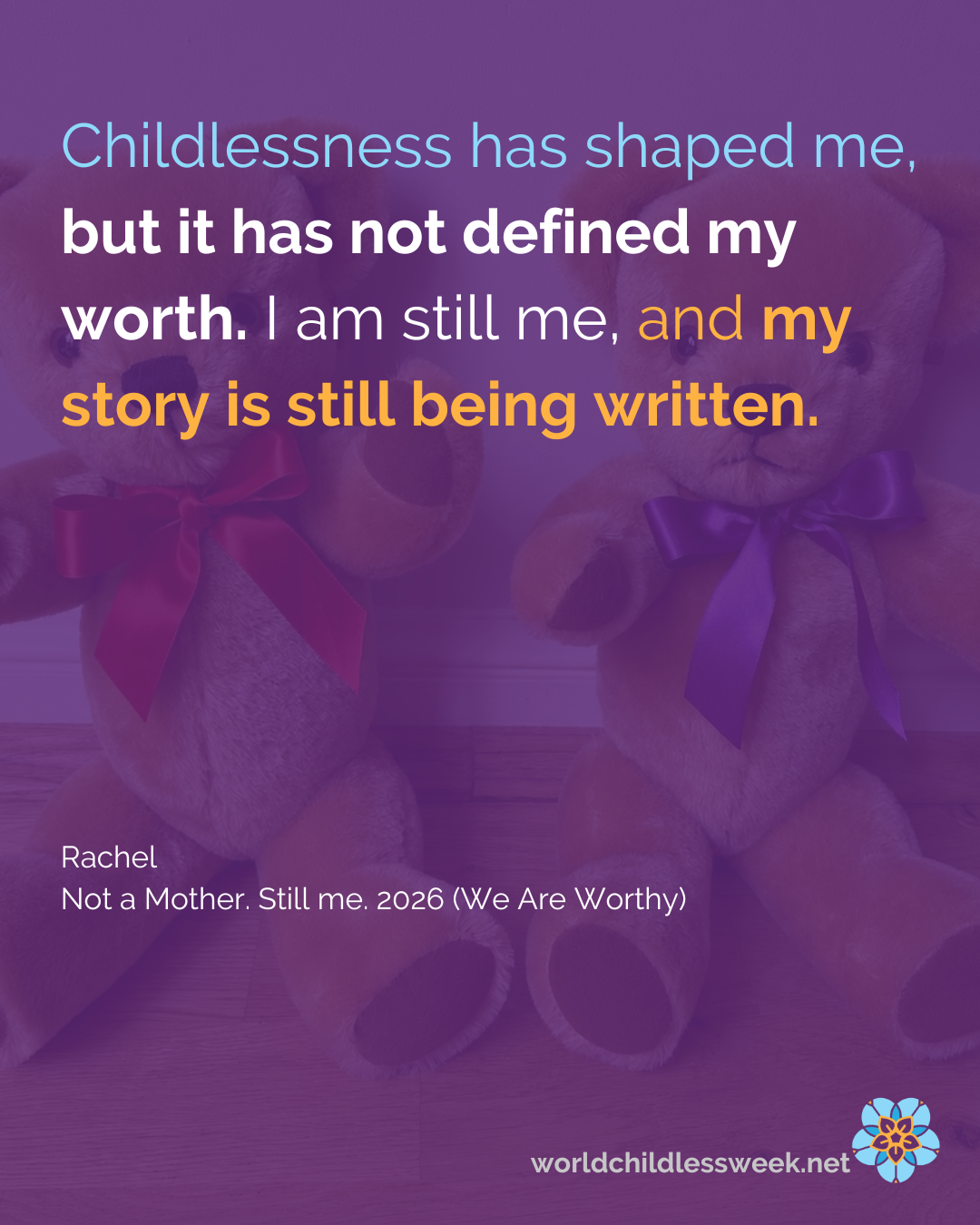
Rachel
I am more than my childlessness
I have a good career, I love to travel, and I enjoy music and making things. I’m yet to become a good cook, I could do more exercise, and my garden could certainly look better. Childlessness is part of my story, but it is not the whole story.
I always expected to become a mother
For much of my life I assumed parenthood would happen. I was going to be married at 25 and have two children – I even bought them teddy bears – the same type that I’d had as a child, when I thought the maker might be closing. By 37, I had not met the “right”man, so I decided to try to become a “solo mother by choice”.
My body had other plans
In April 2020, just after my 37th birthday, I had my fertility tested at a clinic and was found to have low ovarian (egg) reserve. Like many others, I’d taken my fertility for granted. If I could give one bit of advice to my younger self, it would be to consider egg freezing in my late 20s – not a guarantee of parenthood but it’s easier to get pregnant with younger eggs in good supply than 37-year-old eggs in low supply. What, I hear you cry, 37 isn’t old to have a child. Nope, I agree, but not everyone’s body gets the memo. Mine didn’t.
Hope and heartbreak can exist at the same time
I started IVF in October the same year, excited about the possibility of becoming a parent – I started thinking about baby names, whether I’d need a bigger house, how I’d afford childcare and what life might look like. Then bam, I went into theatre for my first egg retrieval and my clinic retrieved no eggs! Over the 4 years that followed, I tried various treatment plans (known as protocols), had all sorts of tests and tried various treatment add-ons. In total I had 12 eggs collected over the course of six IVF cycles (a low number), and, following fertilisation, 6 of those developed into good blastocyst stage embryos that were suitable for embryo transfer. I was delighted when the stick showed a 2nd line for the very first time, and gutted when a few days later that line began to fade – I’d experienced a chemical pregnancy, or early loss. The other 5 embryos didn’t stick, and I never saw another positive test. We never found out why the embryos didn’t implant.
Workplace support can change the experience
People going through fertility treatment can live with years of uncertainty, anxiety and intense pressure. Divorce, moving house and bereavement are often cited as some of life’s most stressful experiences – I would add infertility and IVF treatment to that list!
IVF is incredibly unpredictable – you don’t know how your body will respond to the medication, exactly when scans and procedures will be scheduled, or how you will feel mentally, emotionally and physically from one day to the next. Many people, including me, experience difficult side effects such as severe headaches, cramping and nausea, and the anxiety leading up to scans or results at different stages of the process, along with the lows when a cycle is cancelled or fails, can be immense. All of this makes planning – both personally and professionally – very difficult.
Having an employer who supports you through infertility and IVF can make a significant difference. I was fortunate to work for an organisation that gave me the flexibility I needed to work from home when I was feeling unwell, trusted me to adjust my hours around appointments and procedures, and enabled me to take time off when my final cycle failed. That support did not remove the difficulty of what I was going through, but it did ease some of the pressure of trying to manage treatment alongside my working life.
When people look back on an employer and decide whether they would recommend that organisation to friends and family, they often remember how they were supported or not supported during the most difficult times in their lives – support in these moments really matters and it stays with people. This is why I am now passionate about raising awareness of what it is really like to go through IVF while working. I want people going through treatment to feel better understood, and I want managers and HR teams to feel more equipped to support them. It is about recognising the practical realities of fertility treatment – the short-notice appointments, physical side effects, emotional strain and uncertainty – and finding a balance that works for both the individual and the employer.
After IVF ends
Over the years, I spent tens of thousands of pounds on IVF. It dominated my life, and my mental health suffered. Sadly, this is not just my story; many thousands of women and men go through fertility treatment and come out of the process not only without a child but also carrying debt. For me, my mortgage is now bigger than it might otherwise have been, and it may be a little longer before I can retire – which reminds me, I really must buy that lottery ticket! Do I regret spending the money? No. But was the cost part of my decision to stop trying? Yes, absolutely.
IVF also has a physical effect on your body, and it can take time for your body to find its rhythm again after treatment ends. In my case, I was also on blood thinners and steroids during my final cycle, and so there was a period of tapering off these medications, as well as adjusting to the changes in hormone levels.
Similarly, whilst some people may experience an element of relief when they finally get off the IVF rollercoaster, for most people, the emotional and mental impact of infertility and IVF does not simply end when treatment stops. This is especially true when treatment does not result in a baby. For some people, the stress of the process can even lead to post-traumatic stress disorder (PTSD).
I saw a clinical psychologist during my final treatment cycle and continued seeing them for 18 months after my treatment ended unsuccessfully. I have accepted being childless now, but it can still be difficult at times to reconcile the life I am living now with the one I imagined when I was younger, and some things do still occasionally catch me off guard and bring emotions to the surface.
Social media:support and triggers
There is a wealth of helpful IVF and childless support groups on social media, many of which I have been actively engaged with over the years. But the ads for baby products and baby groups when you’re not pregnant or don’t have a baby… Urgh! I’ve never engaged with baby products online – why are you showing these to me?! Wouldn’t it be wonderful if there was a setting where you could switch certain types of ads off… maybe the top 5 categories you don’t want to see: the latest diet ones if you’re recovering from an eating disorder, the gambling ones if you’re an addict, the baby ones if you don’t have children; and prioritise the ones you’re actually interested in – trip abroad anyone?
Then there are times of the year when your feeds are full of posts about children – Mother’s Day, Father’s Day, Christmas, start of the school term, school holidays, World Book Day, etc. I’ve generally been lucky in that I haven’t been badly triggered by seeing these things, though seeing baby pictures does still sometimes make me clucky and sometimes I think, “one day”, and then remember. However, I know that for many childless people, these times of year can be bittersweet, painful or very triggering.
Words matter
People often say things with good intentions but, when you’re grieving something you want, some comments can land painfully. I have heard many versions of:
“Just adopt.”
“Get a dog.”
“You’re lucky you don’t have children.”
“You’ve got a good job.”
“Some things are just not meant to be.”
“You must have so much money.”
“Oh, I assumed you didn’t want kids.”
It is of course completely okay not to want children, and I have total respect for people who choose a different path for themselves. However, for people who are not childless by choice, it’s better to avoid minimising their grief, assuming their story, or trying to fix things that can’t be fixed. What I have realised over the years is that support is not about finding the right answer; often it is simply about listening and being present.
I still want to belong
The world is full of people like me. You likely passed one of us on your way to work this morning, or perhaps you’re sitting next to one of us now! You can talk to me about your children, I enjoy seeing the interactions between children and their parents, and I want to be invited to my niece’s or friend’s child’s birthday party, even if I decide I can’t attend. I don’t want to be excluded from the lives of friends and family who have children simply because I don’t, or for people to feel they need to hide that part of their life around me. However, I do recognise that everyone’s experience is different and, for some people, especially at first, these situations can feel incredibly raw. I have had moments myself when something has caught me off guard and I have reacted from a place of pain.
So, what can you do to support a friend, family member or colleague experiencing infertility and childlessness?
Include them in child-related conversations and activities, but respect that sometimes they may want to step back.
Arrange to do things that don’t involve children.
Have some conversations that aren’t child-related.
Hear their opinions on child-related matters – I can’t give you an informed view on the right nappies to buy (though wait, didn’t I see an advert for that?!), but my views on access to social media and the education system are just as valid.
Recognise that time without children is just as valuable as time with children, for example, childless people want Christmas off work with their friends and families too.
Be sensitive about pregnancy announcements – they’re likely happy for you but may prefer to process their personal emotions in private than in front of others, so consider telling them privately.
Look for occasions to celebrate people you know without children.
On that last point, our society is very good at celebrating new babies and children’s milestones, and many people without children willingly and happily celebrate those moments with the people they love – they buy presents, cheer from the sidelines at school plays, remember birthdays, ask about exams, and delight in seeing the next generation grow up. They often invest their time, thought, generosity and love into the lives of others, but it can sometimes feel one way, and there may be fewer obvious occasions when their own lives are also celebrated. There is no handmade card on Mother’s Day or Father’s Day, no child proudly handing over a Christmas present bought with saved-up pocket money, and fewer socially recognised milestones that say, “you matter too”. People without children still want to feel special, remembered and celebrated for who they are and the lives they are building.
My future is meaningful
I don’t have the life I imagined when I was younger, but my life is still full of possibility. I continue to travel, learn new things, build relationships, and make plans for what comes next. Currently, I’m part of an exciting community music project where I am playing the flute again for the first time in over 20 years. I’m also writing my first book and looking forward to travelling in India later this year. Childlessness has shaped me, but it has not defined my worth. I am still me, and my story is still being written.