Frankie Hockham
If I were sitting in a room with people willing to listen, these are the ten things I would want them to understand about how being childless has shaped me.
1. I learned that you can grieve a future that never happened
For a long time, I imagined I would become a mum.
It felt less like a decision and more like an expectation. One day there would be children, family routines, birthdays, school photographs and all the ordinary moments that make up a life.
When that future did not happen, I had to grieve something other people could not always see.
There was no single moment of loss that everyone recognised. No funeral, no sympathy cards and no clear ending. I was grieving children I never met and a version of my life that never arrived.
That grief has shaped me deeply. It taught me that loss does not have to be visible to be real.
2. I learned how little control we sometimes have over our futures
I did not choose to be childless.
I did not choose infertility, treatment, disappointment or loss.
For a long time, I believed that wanting something enough, working hard and doing everything asked of me would somehow be enough. IVF challenged that belief.
IVF is sometimes talked about as though it is a straightforward option or a lifestyle choice. It is neither. Treatment can be physically exhausting, emotionally brutal and financially draining, and there are no guarantees.
It means living between hope and fear. It means trying to carry on with work, relationships and everyday life while your future seems to depend on appointments, medication and results you cannot control.
Going through treatment changed the way I saw my body. For a long time, I felt it had failed me.
I have had to learn that some things cannot be fixed through effort, determination or wanting them badly enough.
What happened to me was not a personal failure.
3. I learned that there are no simple answers to childlessness
People sometimes ask why we did not “just adopt”.
That question may sound simple, but it carries a great deal of judgement.
Adoption is not a replacement for a biological child, a cure for infertility or the automatic next step after treatment. It is a separate path with its own responsibilities, assessments and emotional complexities.
Children who need adoptive families deserve parents who have chosen adoption for the right reasons, not people who have been pressured into it because others believe they should be grateful for any route to parenthood.
Being repeatedly asked about adoption made me feel as though I had to justify our decisions, our grief and the limits of what we could cope with.
It also made me wonder why the people who present adoption as such an obvious answer did not choose it themselves.
There is no single solution to childlessness. There is no path that is right for everyone, and there is no decision that removes the loss of the future you originally imagined.
4. I learned how easily childless people become invisible
Childlessness has made me notice how strongly society is built around the assumption that everyone will become a parent.
You see it in advertising, television, newspapers, workplaces, politics and everyday conversations.
Families are often spoken about as though they consist only of parents and children. Women are asked when they are going to have a baby. Politicians talk about “hard-working families” in ways that can make people without children feel as though their households count for less.
The press can portray childlessness as selfish, tragic or suspicious. Advertising often presents parenthood as the natural destination of adulthood. Even well-meaning conversations can leave no room for those whose lives took a different path.
Pronatalism bends the way childlessness is seen. It places parenthood at the centre of adulthood and can make every other kind of life appear incomplete.
Being overlooked in this way has made me more determined to speak honestly.
I do not want childless people to remain invisible simply because our lives do not fit the usual story.
5. I learned to defend the value of my time and my life
Being childless does not mean my time is less valuable.
It does not mean I should always work Christmas, cover school holidays, stay late or rearrange my plans because someone else has children.
Parents may have responsibilities that I do not have, but I have responsibilities, relationships and needs of my own.
My marriage matters. My friendships matter. Rest matters. The things that bring meaning to my life matter.
I have had to learn to set boundaries and challenge the assumption that childless people are always more available.
Fairness should not depend on whether someone is a parent.
6. I learned that grief and happiness can exist together
For a long time, I thought moving forward meant leaving the grief behind.
It does not.
The sadness still appears. It can be triggered by a pregnancy announcement, a family celebration, Mother’s Day, a casual comment or a glimpse of the life I once imagined.
But grief is no longer the whole story.
I can be happy for someone else and sad for myself. I can love the life I have and still mourn the life I did not get. I can feel grateful and heartbroken in the same moment.
Those feelings are not contradictions.
I have a sad story, but I do not have a sad life.
7. I learned which relationships could hold my pain
Childlessness changed some of my relationships.
There were people who listened without trying to fix me. People who allowed me to be honest, even when what I said was uncomfortable. People who understood that I could love them and still need distance from a baby shower, christening or family celebration.
Those relationships became stronger.
Other relationships became harder. Some conversations seemed to revolve entirely around children. Some people disappeared because they did not know what to say. Others expected me to move on according to a timetable that suited them.
Pregnancy announcements could bring genuine happiness and private pain at the same time. At times, I needed to step back from people or situations, not because I stopped caring, but because I was trying to protect myself.
I learned that protecting myself was not the same as rejecting someone else.
Sometimes taking a step back was the only way I could keep going.
8. I had to rebuild my identity and sense of worth
For a long time, being unable to have children felt like a failure.
I questioned whether I was less of a woman, less of a wife or somehow incomplete because I had not become a mother.
The world often reinforces the idea that motherhood is the natural fulfilment of womanhood. When it does not happen, it can be difficult not to feel that you have fallen short.
I have had to separate my worth from what my body could not do.
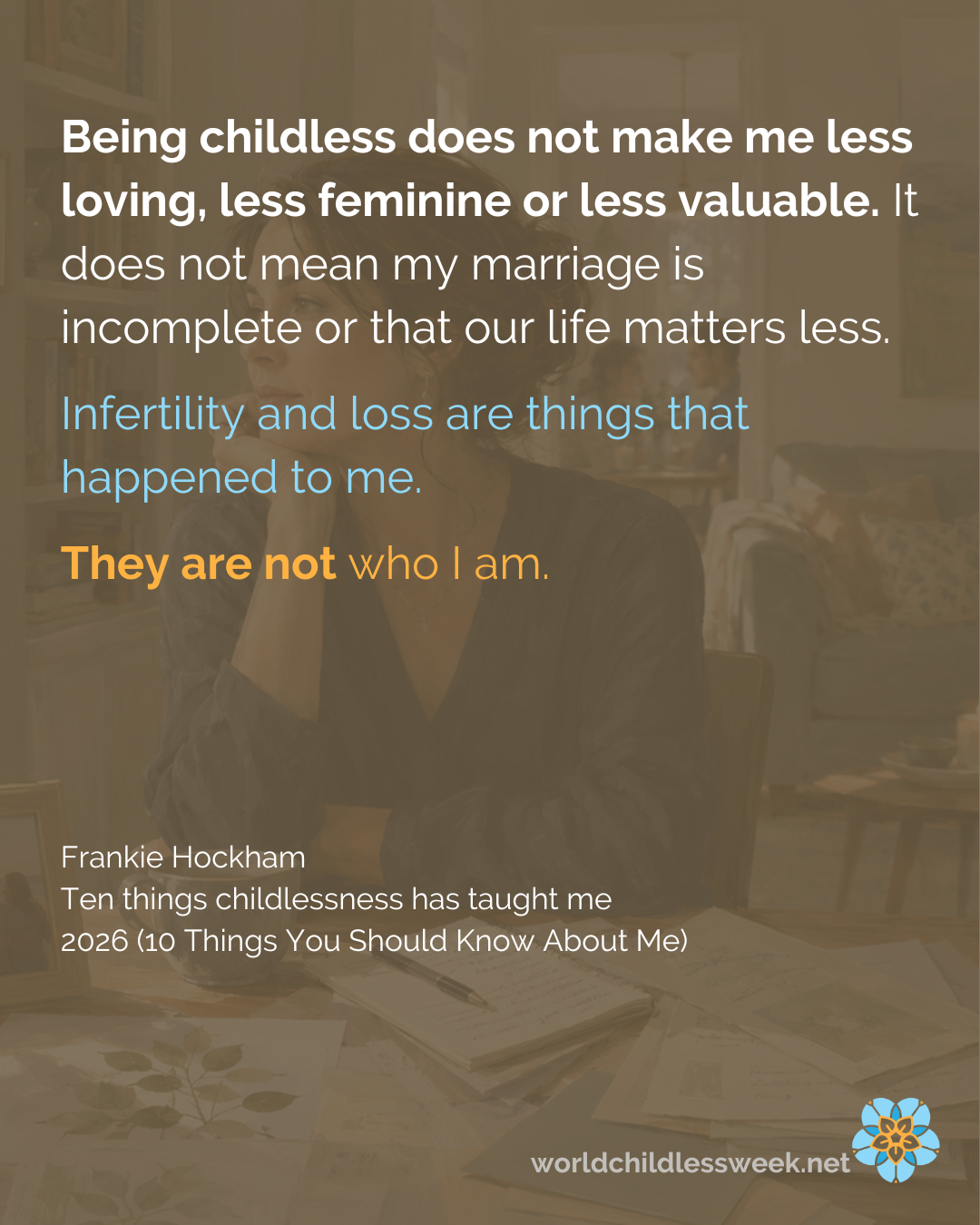
Being childless does not make me less loving, less feminine or less valuable. It does not mean my marriage is incomplete or that our life matters less.
Infertility and loss are things that happened to me.
They are not who I am.
9. I learned to find new dreams without pretending they replaced the old ones
There was a time when I could not imagine a future that did not include children.
When that future disappeared, everything ahead of me felt empty. I had spent so long picturing one kind of life that I did not know how to imagine another.
Over time, with my husband’s support we began to build something different.
In our spare time, we set up and now run a charity. In many ways, it has become our “baby”. It is something we have nurtured, worried about, protected and watched grow. It takes time, energy, patience and love, but it also gives us purpose and the opportunity to make a difference in other people’s lives.
I know that running a charity is not the same as raising a child, and I would never pretend that it replaces the children I wanted. Nothing could do that.
But it has given us somewhere else.
Creating the charity showed me that I could still build something valuable. I could still leave a legacy, support others and create change.
The life I have built is not a consolation prize. It is a real life, full of love, laughter, purpose and possibility.
It may not be the future I once imagined, but it is something I am deeply proud of.
10. I discovered strength I did not know I had
I would never have chosen this experience.
But it has changed me.
It has made me more aware of invisible pain and more careful about the assumptions I make about other people. It has taught me to speak when it would be easier to stay quiet, to set boundaries without apology and to rebuild after losing the future I thought was certain.
It has shown me that resilience is not pretending something did not hurt.
Resilience is acknowledging the pain and still continuing to create a life around it.
I am more than my childlessness.
I am a wife, a friend, a daughter and an individual with my own strengths, flaws, hopes, interests and achievements.
I do not want to be pitied, dismissed or reduced to the children I could not have.
I want to be seen as a whole person.
Childlessness has brought heartache, doubt and moments of deep loneliness. It has also brought self-awareness, courage and a stronger understanding of what gives my life meaning.
I did not choose this path.
But I am still here.
My life is different, not lesser.
My voice matters. My relationships matter. My experiences matter.
And I do too.