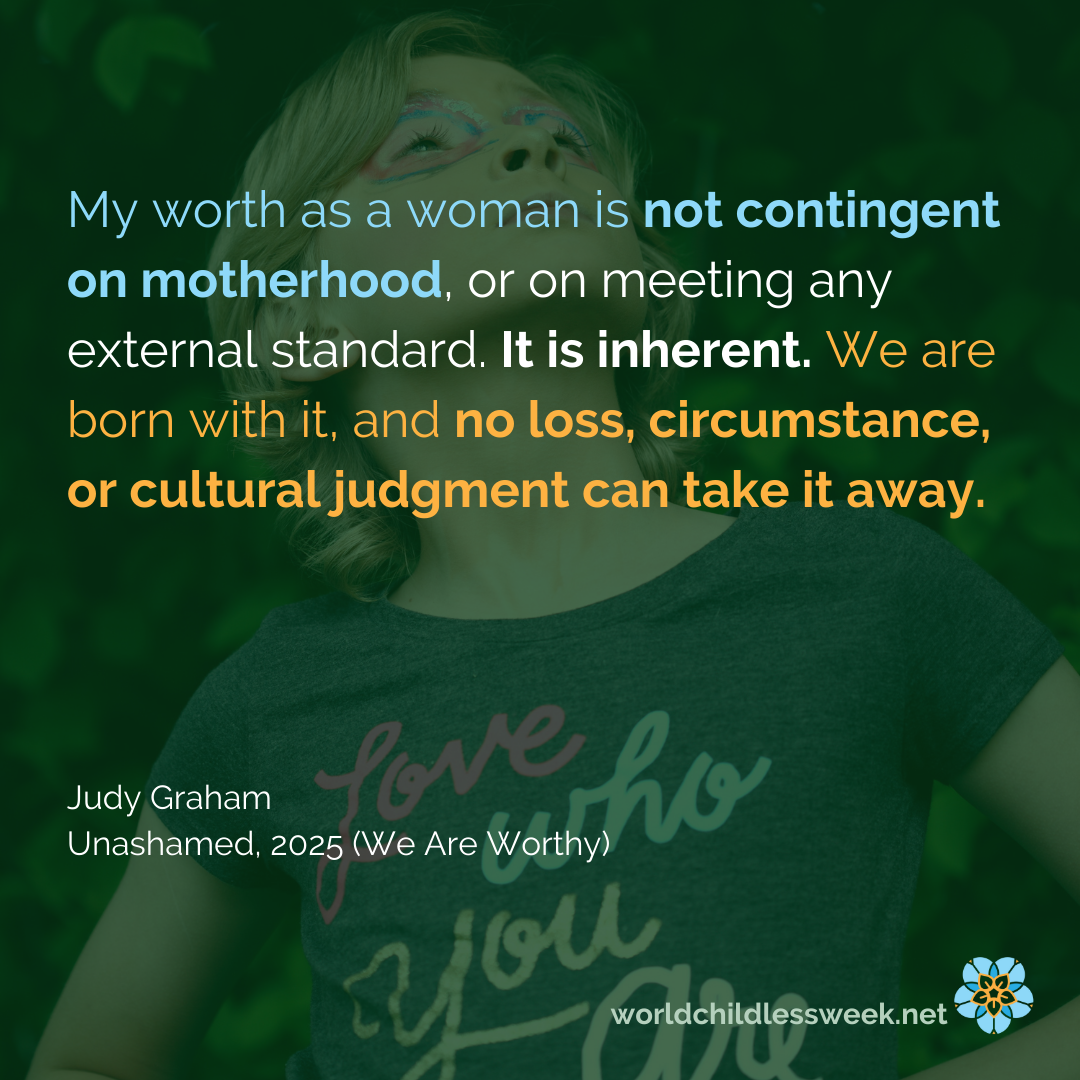
Judy Graham
It’s now well over a decade since I’ve known, really known, I’d never be a mum.
For a long time before and after that time in my 40s when I knew it was over, I silently felt like I’d failed, that I’d failed at life.
I found ways to navigate my grief; the sadness for lost dreams and a future that would never unfold. But even after I’d made peace with my losses, there was still this invisible force holding me back from speaking up, from expanding, from stepping fully into life. I would never have admitted it out loud (because it didn’t feel safe enough), but underneath my “I’m fine” smile was that gnawing sense of failure, of being incomplete andless than.
· At women’s gatherings when conversations circle around children’s milestones.
· At work when colleagues trade stories and negotiate their rosters around family time.
· In casual chats when someone asks, “Do you have kids?” and “No” lands like an awkward silence with the power to scatter people - fast.
So hurtful and embarrassing, those moments had the power to shrink me small, make me want to vanish, and to leave me judging my ownself-worth.
In this society steeped in pronatalism (the gazillion unspoken, relentless messages that a woman’s worth is tied to motherhood),my childlessness felt like a gaping hole in my identity, something I needed to explain, to justify, or to hide.
It took time to untangle things and identify that the invisible force whispering wicked criticism in my ear was Shame, Internalised Shame. The sneaky, icky, sticky flush of Shame that had the power to catch me off guard and make me want to shrivel up and disappear into the floor.
Shame is a deep, embodied response. It thrives on difference and deviating from the status quo can bring Shame rushing in like a frantic saviour to shut things down and get you out of the spotlight – fast. It’s different from Guilt that says, “I did something wrong”. Shame says, “I am wrong”.
Shame thrives in silence and secrecy, so when we feel unseen and unheard it can move in and run the show. But, like a vampire that shrinks from sunlight, shame will loosen its grip when we can spot it, speak it aloud,and start to challenge its criticism (even if it’s quietly to ourselves).
Whose story is this?
Who benefits from me feeling small?
Is this belief even true?
Curiosity is like an antidote to shame. It brings space and perspective.
The shame I carried wasn’t proof of my unworthiness, or a reflection of who I truly was – it was my embodied response to the inherited cultural scripts about women and motherhood that are so freely espoused and easily absorbed.
I found that overcoming shame isn’t a dramatic leap, but a gradual thawing of those parts that felt judged, and small, and frozen. Gently challenging those critical thoughts and finding moments of genuine pride in my life – places where I could say This matters to me, and I’m proud of it. Sometimes it was something small, like the way I’d shown up for a friend in need, the way I’d completed a project with creativity and determination. Other times it was bigger; a professional achievement, a personal breakthrough, being brave in the face of fear, or the resilience I’d built from grieving my losses.
Pride can become a gentle antidote to shame. It doesn’t erase it instantly, but it can be a counterweight – evidence that our lives can be worthy and rich and valuable in ways our pronatalist culture often fails to see. Over time, those small recognitions become a quiet, steady current helping to reconnect with joy. Not necessarily the loud performative kind, but a deeper, more grounded joy in simply being alive and whole.
Instead of looking at life through the lens of what was missing, I began to wonder:
· Who am I when shame doesn’t run the show?
· What would it feel like to truly inhabit my days?
· What brings me alive?
· How do I want to connect?
These days I stand taller. I don’t shrink inside or fold in on myself when I’m surrounded by parents. I no longer feel the need to stay silent, over-explain my story or justify my existence. Childlessness is part of my story, it’s not all of my story, and I have plenty to contribute.
Self-acceptance, I’ve learned, isn’t a one-time destination. It’s a daily practice. Sometimes shame still whispers in my ear, but I recognise its voice — an echo of outdated cultural scripts — and I have tools to meet it with compassion instead of collapse.
Most importantly, I’m rewriting the story I inherited. My worth as a woman is not contingent on motherhood, or on meeting any external standard. It is inherent. We are born with it, and no loss, circumstance, or cultural judgment can take it away.
I am worthy.
You are worthy.
We are worthy.
And in place of that old shame, something new has taken root: pride. Pride in the resilience it took to navigate the heartbreaking loss of motherhood. Pride in my unconventional chosen family. Pride in building a life that’s mine. Pride in my relationships, contributions, and simply being myself.
If you’re reading this and feeling any sense of “less than,” please know this:
You are not broken. You are not incomplete. Your worth is not up for debate.
We live in a world that measures women by narrow, outdated standards — but those standards are not the truth of who we are.
You are worthy simply because you exist.
Your life, as it is right now, has meaning.
And you are allowed to take up space — in conversations, in communities, in the wide, beautiful story of your life.
Sending so much gratitude to World Childless Week for giving us this space for sharing our stories with compassion and truth. It’s vital to our wellbeing to find people and spaces where we are seen and heard and accepted just as we are – reclaiming our right to exist fully in the world.