Judy Graham
World Childless Week Ambassador
March is Endometriosis Awareness Month — and my thoughts are with the women, their bodies, the hurts, and the stories that have been ignored or minimised for too long.
During Endometriosis Awareness Month I also find myself thinking about how endometriosis was the silent sword that sealed my childlessness.
Endometriosis wasn’t the only factor in me becoming childless. I think of myself as childless by circumstances. During my 20s and early 30s I didn’t have a secure base, there was heartbreak and relationship challenges, and the low self-esteem that kept me staying too long with men who couldn’t commit. I lived with the comforting illusion that I had time.
As far as endometriosis goes, I didn’t know it was inside me - quietly destroying my ovaries, and my fertility - until it was too late.
When My Body First Spoke
I was 12 when I started menstruating — a young 12, just starting high school, surrounded by unfamiliar teens and anxiety about fitting in. From the beginning, my periods were heavy and painful. I remember the heavy flow that would occasionally leak onto my school uniform leaving me mortified, the cramping that bent me double, the drawing achy feeling in my legs that left me pale and sweaty, moments from fainting.
Whenever I said how much it hurt, the message was the same:
That’s just how it is — it’s part of getting your period.
But other girls didn’t seem to be doubled over like I was, so it seems that I gaslit myself into believing that I was being weak, dramatic, too sensitive. I learned to say, “I’m fine,” even when I wasn’t. I learned to suffer quietly, and to doubt myself.
That silence and doubt cost me years of clarity, diagnosis, and appropriate care.
At 16, I started taking the Pill — not for painful periods, but for acne. Because somehow, in the patriarchal logic of 1980s medicine, acne was a more acceptable “medical issue” than menstrual pain or hormonal care.
Miraculously, the Pill also helped reduce my pelvic pain. For a decade I had relief - fewer days off school and work, and I managed along just like other women seemed to. But the thing is, I didn’t know that taking the Pill was managing/masking the symptoms of a silent disease, because I didn’t even suspect that I might have Endometriosis.
In my mid-30s, when I was in a more stable position and hopeful relationship, I went off the Pill - and the pain returned — with a vengeance! Too many times, I’d be curled up on my office floor at work with such fierce pain that I couldn’t speak, or move, just crying out in agony. Colleagues offered to take me to hospital – but I’d lost so much confidence in the system, and I just wanted to get home. I had learned to ride out the pain - to put on a brave face.
The Diagnosis
Eventually, I went to a gynaecologist who’d been recommended by a trusted friend. After an internal ultrasound, he told me it was very likely to be endometriosis, as it looked like my pelvic organs were fused together. Surgery was the only way to diagnose for sure. And when that finally came, it showed my ovaries were decimated by endometrial lesions, and my uterus and organs were riddled with deep lesions. To say, I was devastated is an understatement – I was numb.
Surgical treatment removed the disease and provided relief from pain and fatigue, but it revealed how damaged my reproductive organs were - and that I’d never have my own children. The realisation landed hard and this time I found myself curled up with eons of hurt and grief as I felt things shatter around me.
A Legacy of Silence
It turns out that in my maternal line, there was a history of reproductive issues — undiagnosed pain, traumatic births, hysterectomies. Women were told to rest, take in the sea air, and get on with things. They were shamed and silenced.
Sadly, none of my elder women had even considered that my young self might be facing serious gynaecological problems – until it was too late. They didn’t put together the genetic threads. We were all very good at putting on a brave face and keeping our pain inside. What a tragedy!
It wasn’t until I had a radical hysterectomy at age 41 that my mum — then 73 — wondered aloud if she too might have had endometriosis, and if her mother did too.
Understanding the Reality
Endometriosis is not rare, it’s common — but it is diagnosed way too late.
According to Australian national data:
Around 1 in 7 (about 14%) girls and women live with Endometriosis.
About 1 in 7 women born between 1973-1978 were diagnosed by the age of 44-49; younger women are starting to gain earlier diagnosis.
The condition often goes undiagnosed for 6–8+ years from the onset of symptoms, meaning many suffer in silence before they receive a diagnosis.
Endometriosis contributes to thousands of hospitalisations each year
About 30–50% of women with endometriosis experience fertility problems, though rates vary across studies and often depend on how advanced the disease is.
Despite improvements in awareness and diagnostic tools — like more sensitive ultrasounds and specialist pelvic pain clinics — surgery remains the only definitive diagnostic method. This leads to delays, uncertainty, and ongoing suffering for many.
The Invisible Toll: Endometriosis and Childlessness
Here’s where the data — and the advocacy — feels personal and urgent.
The leading endometriosis websites quite rightly talk about pain, diagnostic delays, fertility challenges and treatment options. But there is almost no dedicated support or acknowledgement for women who enter into permanent involuntary childlessness.
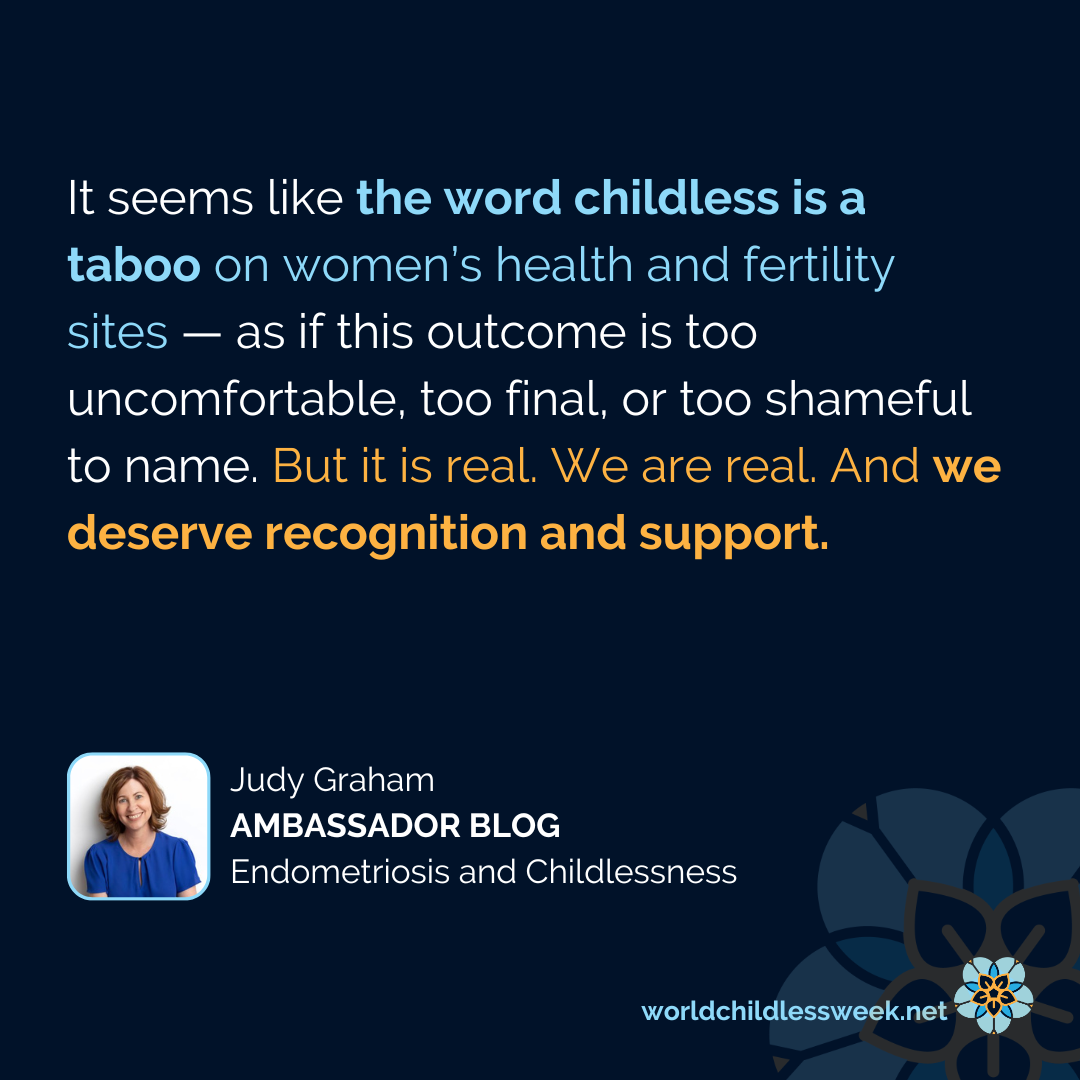
It seems like the word childless is a taboo on women’s health and fertility sites — as if this outcome is too uncomfortable, too final, or too shameful to name. But it is real. We are real. And we deserve recognition and support.
Many women with endometriosis do conceive — sometimes naturally, sometimes with reproductive technologies — but many others do not. And for those who are involuntarily childlessness, the emotional grief is real, the psychological and social adjustment is challenging, ongoing, and often unseen.
What We Need for Change
Progress has been made, but the journey is still far from equitable or empowering.
We need faster, more accurate diagnosis.
We need better pain and symptom management.
We need fertility support that acknowledges grief and loss, not just clinical outcomes.
We need more research into why endometriosis affects some women’s reproductive capacity more severely than others.
We need community understanding that childlessness is an experience worthy of care, compassion, and space in the conversation.
I’m 55 now. It’s 13 years since I became permanently childless – and many things have evolved in my life. I have a lot more compassion for my younger self – for her pain and inexperience.
I wish I had known about my endometriosis way earlier.
I wish I’d had more transparency about the options and realities involved in navigating my health and having a family.
I wish I’d had more emotional support to help me find strength and skills to deal with being a woman in a patriarchal world
AND
I’m grateful to have shaped the life I have now and to have found my voice and the solidarity of other women when we speak up together.
I now know that more than one thing can be true at the same time.
I’m happy and content with the life I’m living and how I’m finding myself in the process - AND - I also yearn, ache and mourn for those who are missing from it and the opportunities I missed out on.
For those women who know these kinds of pains, losses and mixed emotions:
You matter. Your story matters. Your losses matter. Your body’s pain matters. Your wellbeing matters.
You are not alone.
I share my story to lift the veil of silence and shame, and I extend a gentle invitation to connect with your own story, perhaps there are similarities and differences, and threads that connect us as women who are childless not by choice.
*I want to acknowledge recent media coverage in Australia on Endometriosis and some women affected by a specific Surgeon – this has been deeply upsetting and unsettling and our hearts are with all the women affected directly, or indirectly.
Information and support you can trust is available at:
Endometriosis Australia - https://endometriosisaustralia.org/
Qendo - https://www.qendo.org.au/
*Endometriosis is a common, but complex disease and affects women in different ways - all our stories and experiences matter, and we all deserve treatments that support our wellbeing.
**For information, support and referral, please go to Endometriosis networks in your country.