Jess Tennant
My relationship with Mother’s Day has changed over time, but it remains not my favorite of the Days.
When we were in the midst of struggling, when it felt like everyone else was celebrating and moving forward in an expected trajectory and we were stuck, two trees standing still, forever outside looking in. It was awful. At first, I wanted to prove that I could do it – that I WOULD be a mother one day and this would NOT always be a holiday where I felt dreadfully left out. I would host brunch (but so we didn’t have to go out somewhere where my un-mother status would be highlighted further) and pretend I was fine.
That did not last long.
Then, I suggested celebrating Mother’s Day on a different day, which took a little convincing, but it freed up my day to do things at home, in the backyard, away from The Stroller Patrol that regularly marched up and down our suburban neighborhood. Those things were a) garden out of sight, b) read in a chaise longue, c) drink a daytime martini. Eventually I got shirts to wear on the day that said things like Mother of Cats in a Game of Thrones style, or Mother of Plants. Mostly, those were amusing to me. I still wear them on the day, particularly if I’m gardening in my front corner garden. Thankfully, our new house is not in an area conducive to stroller parades, which was actually by design.
I stayed (and still stay) off social media around the Day. It was hardest earlier, when people had babies and littles and if they were people who also struggled but were successful where we were not, messages of miracles and actualized dreams and gifts from God stung. Comments of “welcome to the club!” or “So glad you’re finally a mother, it’s the best thing you’ll ever do” continued the death of a million cuts. It felt like everything highlighted how very full everyone else’s day was, celebrating their status as Mom, and how we were so completely left out of that experience.
It’s easier now that most people’s kids are tweens or teenagers, but then there’s the super weird phenomenon of seeing people who were pregnant when I was or who found success as we let go of our dream…and those kids are so old now. It can also be amazing to see those babies as distinct personalities now. I have been fortunate enough to have some of these babies come through my middle school, which is some serious cognitive dissonance. But also, delightful.
The ache that comes with Mother’s Day lessens with each year that passes. I also see more inclusivity – messages honoring “mothers and mother figures,” and cashiers that don’t wish “Happy Mother’s Day” as you check out anytime that weekend. That used to make me into a churlish person, when a cashier would be like, “Happy Mother’s Day!” and I would say “Not a mother, thanks.” Now, if say, a teenage boy at the grocery store wishes me a Happy Mother’s Day, I say “And also to you.” One time a guy said “What?” and I said “Makes about the same amount of sense…” Haha. Again, I think I amuse myself the most.
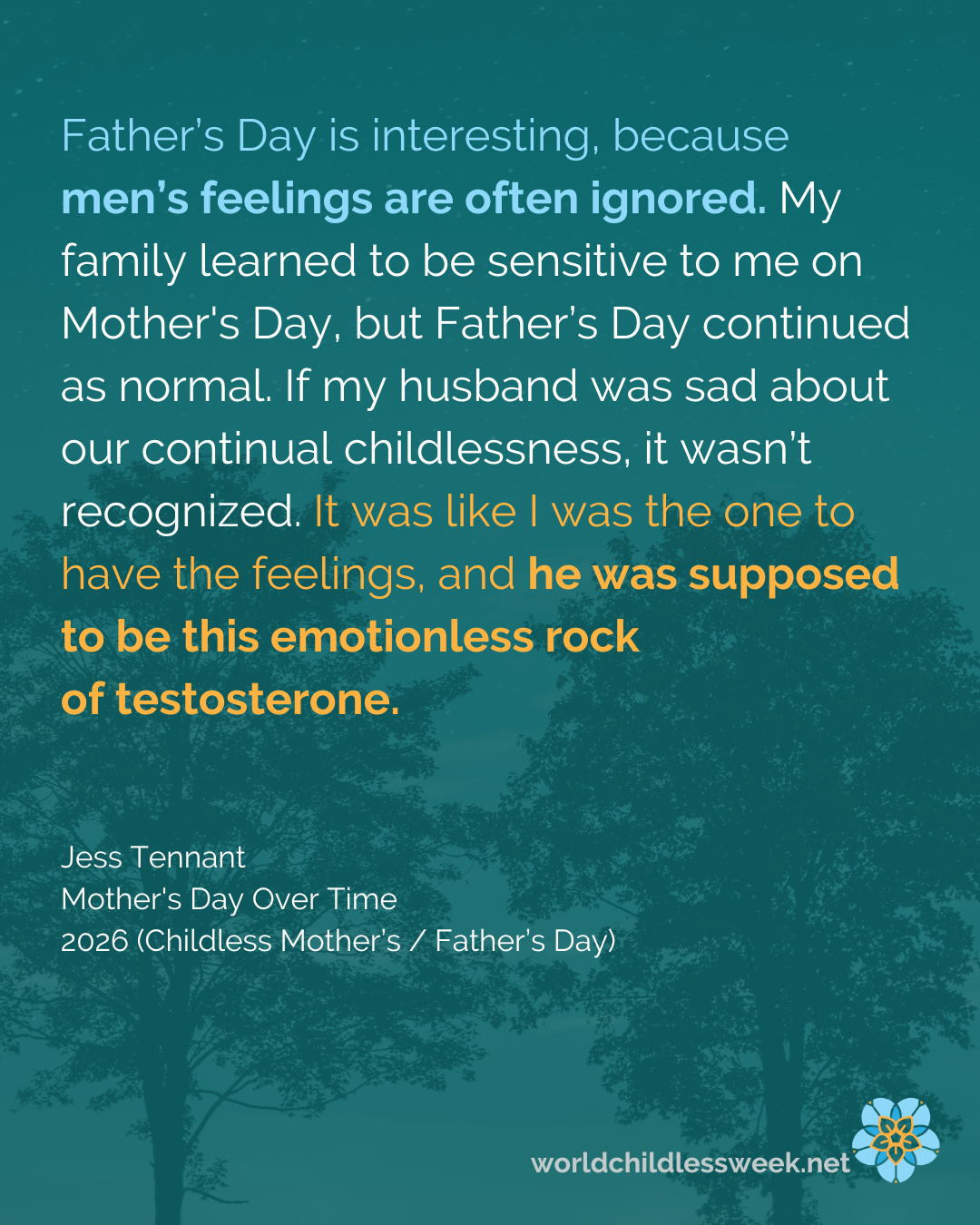
Father’s Day is interesting, because men’s feelings are often ignored. My family learned to be sensitive to me on Mother's Day, but Father’s Day continued as normal. If my husband was sad about our continual childlessness, it wasn’t recognized. It was like I was the one to have the feelings, and he was supposed to be this emotionless rock of testosterone.
One time a few years ago, though, I was looking through my Google feed, and there was an opinion piece written by the comedian Jim Gaffigan. In it, he basically said that including “father figures” or “like fathers” in Father’s Day was an affront to ACTUAL dads. That no one but an actual dad had truly earned any recognition. It was pretty awful and I haven’t been able to watch him do anything since. I did comment though on the piece, and let him (or the editorial people, since he clearly did not give a hoot) know that his stance was completely hurtful and ignored the reality that not everyone who WANTS to be a dad, gets to BE a dad. I was heartened to see a large percentage of comments like mine. It just sucked that they were necessary.
As a teacher, it’s interesting to see the impact of these days on kids. Often, people who had typical families and had experiences where everyone cared about everyone else in a healthy way forget that there are SO many kids who do not have that experience. When the loudspeaker announced on Friday, “Happy Mother’s Day (or Father’s Day), make sure to do something really great for your mom (or dad) this weekend!,” I cringed looking around my class, where there were kids who had parents in prison, who had been removed from their home due to abuse or neglect by their parent(s), whose siblings had been parented by their moms but decided to leave them in the custody of a grandparent… so many difficult situations. The worst was one year where a student had lost his mom to aggressive cancer 2-3 years earlier. His twin brother was in a study hall in my room, and he said “keep an eye on my brother this week, Mother’s Day is really hard on him.” (I asked him how he felt about it, and he said “I’m probably messed up. I haven’t cried yet.” This child’s anger issues made a LOT of sense in that moment.) So, for my Friday Homework line on the agenda, it said, “Have a great weekend! Celebrate moms, grandmoms, dads who are also moms, you know what? Just be nice to anyone who cares for you!” Mother’s Day/Father’s Day are not just hard on adults.
It would be great to have a holiday for those who aren’t parents. In a way, World Childless Week feels like that to me. A whole week dedicated to people like me, who for whatever reason, don’t have kids but are no less worthy and no less full of love for others.