Victoria Hamilton
I used to believe that grief had an ending.
That if you survived something long enough, waited patiently enough, or accepted reality with enough grace, eventually you arrived on the other side of it. You closed the chapter. You moved on.
I know differently now.
Some grief changes shape, but it never truly leaves.
For most of my life, I assumed I would become a mother.
Not because I had every detail planned out, but because it felt like one of those things that simply happened. I met my husband when I was twenty-two. We married when I was twenty-six. We talked about children the way many young couples do—with excitement, optimism, and the quiet confidence that there would be time.
At twenty-eight, I was diagnosed with diminished ovarian reserve.
I still believed that wanting something deeply, working hard, and being patient would somehow be enough.
We couldn’t afford fertility treatments or advanced reproductive medicine. IVF wasn’t a difficult decision for us; it simply wasn’t an option. So we did what we could.
We tracked cycles.
We changed diets.
We took supplements.
We read books.
We kept believing that maybe next month would be different.
Hope, it turns out, can survive on very little.
The years that followed were filled with trying, waiting, hoping, and grieving. There were losses that existed mostly in silence—pregnancies that ended before they truly began, futures imagined and then quietly set aside.
You grieve a life that existed mostly in possibility, while the world around you continues as though nothing happened at all.
People rarely know what to say.
Sometimes they say nothing.
Sometimes they try to help.
“Everything happens for a reason.”
“You can always adopt.”
“Maybe if you stop trying, it’ll happen.”
Over time, I learned how to carry infertility in ways that made other people comfortable.
I learned how to answer questions about children with a smile.
I learned how to celebrate the people I loved as their families grew while quietly mourning the family I had imagined for myself.
People assume there will be another step, another treatment, another possibility waiting just around the corner.
For me, there was always one small word that kept hope alive:
Maybe.
Maybe next year.
Maybe after we had more financial stability.
Maybe after life settled down.
Maybe.
That word carried extraordinary weight.
It softened disappointment.
It created space for possibility.
It allowed me to move forward without completely letting go.
And so I did.
I built a career that I love.
I poured energy into helping other people.
I discovered joy in gardening, nature, and the quiet rituals that make up an ordinary life.
I learned to appreciate butterflies.
I learned to savor slow mornings with iced coffee.
I learned that a meaningful life could exist alongside profound disappointment.
Still, somewhere in the background, maybe remained.
Not loudly.
Not desperately.
Just quietly.
Then, at forty-one, I was diagnosed with ovarian cancer.
Everything happened quickly after that.
Surgery.
Fear.
Medical terminology I never wanted to understand.
Chemotherapy.
A radical hysterectomy that removed my uterus, ovaries, and fallopian tubes.
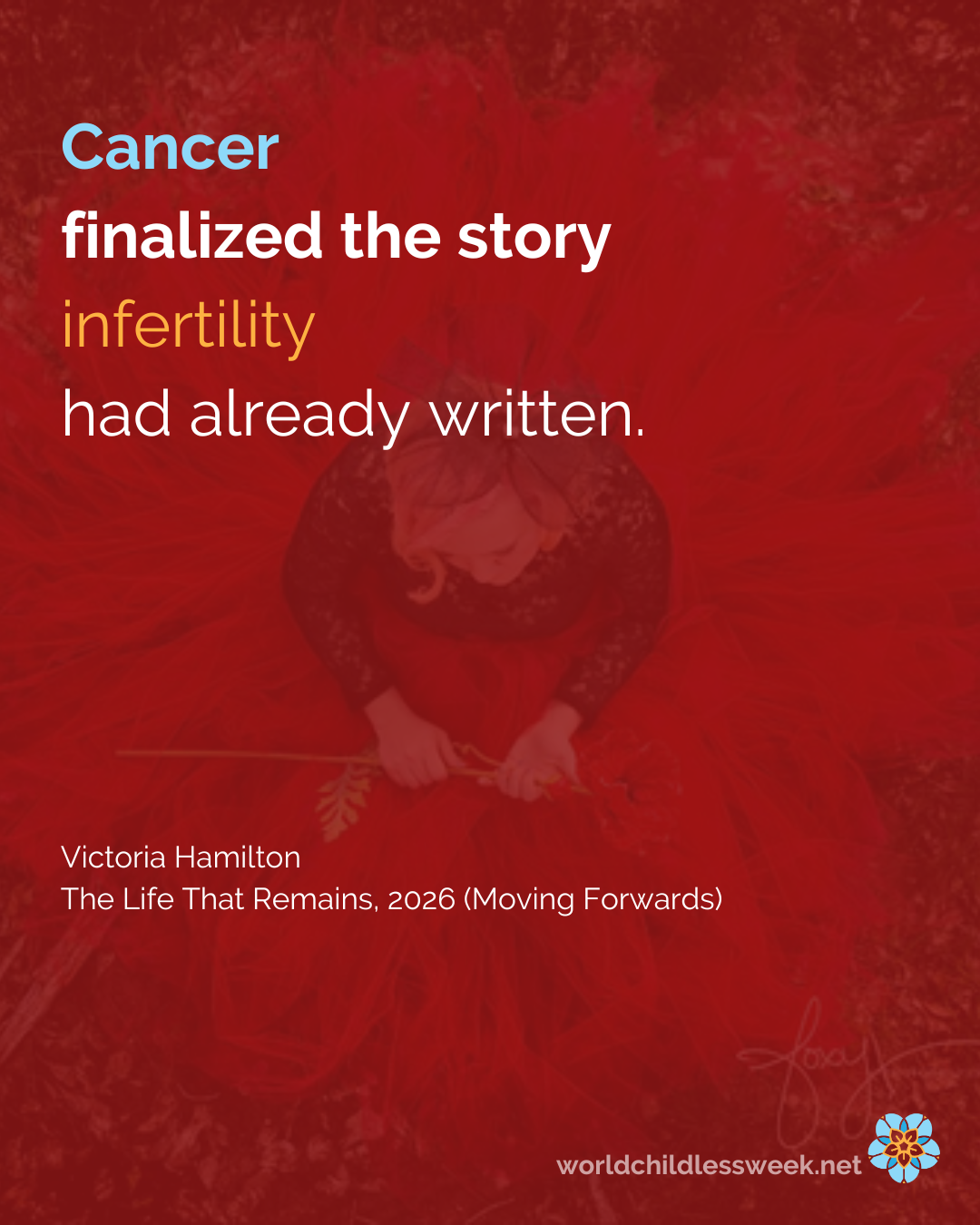
Cancer finalized the story infertility had already written.
What cancer took from me was the word maybe.
There would be no miracle.
No unexpected pregnancy years later.
No tiny corner of my heart continuing to wonder.
The first grief was learning that motherhood might never happen.
The second grief was understanding with certainty that it never would.
And certainty has a weight all its own.
People often celebrate survivorship as though gratitude should replace every other emotion.
I am grateful.
I am grateful to be alive.
I am grateful for surgeons, nurses, and effective treatments.
I am grateful that I get to grow older alongside the person I love most.
But gratitude does not erase grief.
The human heart is capable of holding both.
I can celebrate clear scans and still ache for the children I never had.
I can feel joy in my marriage while mourning experiences we missed.
I can be thankful and heartbroken in the same breath.
These truths coexist.
No one really prepares you for what comes next.
People congratulate you and expect life to resume.
But what is normal after years of infertility and a cancer diagnosis that closes the final door on motherhood?
What does moving forward actually mean?
For a long time, I thought moving forward meant moving on.
Leaving something behind.
Getting over it.
Finding closure.
I no longer believe that.
Moving forward is not moving on.
I have not moved on from infertility.
I have not moved on from cancer.
These experiences shaped me. They changed me. They will always be with me.
What has changed is how I carry them.
I no longer measure my life solely by what is missing.
Instead, I notice what remains.
I notice my husband, who has walked beside me through every disappointment, every surgery, every uncertain future, and every small victory.
I notice the butterflies in my garden.
I notice the comfort of familiar routines.
I notice quiet mornings that begin with iced coffee and a few moments of peace before the day begins.
I notice laughter returning when I least expect it.
I notice new dreams forming in places that once felt permanently empty.
For me moving forward looks like: planting flowers after seasons of loss; making plans for the future without pretending the past didn’t matter.
It is allowing grief to exist without permitting it to become the only story we tell about ourselves.
It is choosing to participate in life, even when life has not unfolded according to plan.
The love I carried for the children I never had did not disappear.
It simply found other places to live.
It exists in my marriage.
In my home, my garden, and the deep appreciation I have developed for ordinary moments that once felt insignificant.
The life I imagined is not the life I am living.
Some days, that truth still hurts.
I suspect it always will.
But I have learned that a life does not have to resemble your original plans in order to be meaningful.
It does not have to be free from grief in order to contain joy.
I did not choose infertility.
I did not choose cancer.
But I can choose what I do with the life that remains.
Today, that means tending my garden.
Watching butterflies.
Loving my husband.
Drinking iced coffee on quiet mornings.
Allowing myself to grieve without allowing grief to define every part of who I am.
I still miss the life I once imagined.
I probably always will.
But I am learning that moving forward is not about forgetting what was lost.
It is about making room for what still exists.
And the life that remains is still worthy of love, meaning, and the possibility of new beginnings I never expected to find.