Alexandra Paul
For a long time, I thought my life would follow a fairly familiar pattern.
Career. Relationship. Marriage. Children.
Not necessarily in that order, and certainly not according to some meticulously organised five-year plan — anyone who knows me will appreciate how unlikely that would have been — but children were somewhere in the picture.
Except somewhere along the way, the children didn’t happen.
Being childless is a strange thing because it isn’t one single experience. There is grief in it, certainly, but it is a peculiar kind of grief.
You are grieving people you never actually met.
You can miss a child who never ran into your bedroom in the morning. You can wonder about the sound of a voice you never heard, a personality you never got to know, or whether they would have had your eyes, your sense of humour — or, perhaps, your inability to remember where you put your keys.
You grieve experiences as well as people.
The first day at school. Birthdays. Christmas mornings. Teenage arguments. Graduations. Weddings, perhaps. The possibility of grandchildren.
Even the completely ordinary things.
Who would they have become?
Would we have been close?
Would they have liked music?
Would they have inherited my neurodivergence?
And would knowing what I know now have helped me understand them in a way that I wasn't able to understand myself?
Those questions don't necessarily disappear because you get older. But I have found that they change.
Grief changes shape.
There are the obvious moments — pregnancies and births around you, Mother’s Day, family occasions — when childlessness can suddenly become very visible.
But sometimes it arrives much more quietly.
Seeing a mother and adult daughter having coffee together.
Hearing someone complain affectionately about their grown-up son ringing them for advice.
Watching families change as children become adults and parents eventually become grandparents.
And occasionally there is that tiny internal thought:
I wonder what that would have been like for me.
There isn't always devastation attached to it.
Sometimes it's simply a small ache.
And perhaps that's one of the things I've learnt about grief. It doesn't have to be enormous to be real.
I can be happy with my life and still occasionally feel the absence of the life I thought I would have.
Those things are not mutually exclusive.
Because there is also a life that did happen.
And, more recently, I have started looking at that life through a completely different lens: neurodivergence.
Receiving an ADHD diagnosis later in life has caused me to revisit so many things I had previously filed under Alex being Alex.
The enthusiasm. The exhaustion. The enormous ideas. The abandoned ideas. The ability to throw myself wholeheartedly into something I love, while somehow remaining completely incapable of dealing with a small pile of paperwork sitting six feet away.
The periods of being incredibly productive followed by periods when everything felt like far too much.
The tendency to become completely absorbed in something interesting while forgetting something supposedly important.
The constant feeling that other people had somehow been given an instruction manual for everyday life and I had missed the day they handed them out.
Suddenly, quite a lot made sense.
And then came another kind of grief.
Because a late diagnosis can be wonderfully validating while simultaneously breaking your heart.
There is enormous relief in finally having an explanation.
But almost immediately behind the relief came another question:
Why didn’t I suspect this before?
And that question opened a door I wasn't quite expecting.
Because once you understand yourself differently, you start revisiting your past differently.
You remember the times you were overwhelmed and thought you simply weren't coping as well as everybody else.
The things you started with enormous enthusiasm and couldn't finish.
The forgotten appointments.
The procrastination.
The exhaustion.
The emotional intensity.
The times you wondered why something apparently straightforward seemed to require so much effort.
And perhaps most painfully, you remember all the names you quietly called yourself because you didn't have another explanation.
Lazy.
Disorganised.
Too much.
Not trying hard enough.
Over-sensitive.
Chaotic.
Why can't you just get on with it?
Why can't you be more organised?
Why can everybody else manage this?
A diagnosis doesn't erase those years.
It changes their meaning.
And there is comfort in that, but there is grief too.
I grieve for the younger woman who didn't know.
I wish I could sit beside her for a while.
Not to change everything. Not to tell her that life would suddenly become easy.
Just to tell her that she wasn't imagining how difficult some things felt.
That there was a reason she could be highly capable in one area and completely overwhelmed in another.
That needing to work differently wasn't a moral failing.
That she didn't have to spend quite so much energy trying to look as though everything was fine.
And perhaps most importantly, I would tell her to be kinder to herself.
That is the cruelty of hindsight.
You finally acquire the language that would have helped the person you used to be, but you can no longer give it to her.
So there is grief for lost time.
For opportunities I might have approached differently.
For decisions I might have made differently.
For relationships I might have understood differently.
For the amount of energy spent masking, compensating and wondering why I couldn't simply become the organised, consistent person I kept promising myself I was going to become.
There is even grief for the confidence I might have had if I'd understood that difference didn't automatically mean deficiency.
And somewhere in the middle of all of this, my two what ifs meet.
What if I had known I had ADHD earlier?
And:
What if I had had children?
Neither question has an answer.
Perhaps that's why they sit together so naturally.
Both ask me to imagine another Alexandra.
One who became a mother.
One who understood her brain much earlier.
Maybe there is even an imaginary version who got both.
I can visit those lives in my imagination, but I cannot know what they would actually have had.
That is important, because imagined lives have a tendency to be beautifully edited.
And inevitably, I began wondering what motherhood would actually have looked like for me.
Would I have been the mother who forgot it was World Book Day until 10 o’clock the night before and then constructed something spectacular out of a pillowcase, three safety pins and blind panic?
Almost certainly.
I suspect there would have been lost permission slips, forgotten appointments and mornings involving frantic searches for one shoe.
There would probably also have been music.
Lots of music.
Ridiculous made-up songs about brushing teeth, getting dressed and finding the missing shoe.
There would have been dancing in the kitchen and probably far too many musical instruments within grabbing distance.
I imagine I would have encouraged creativity, imagination and curiosity.
And I suspect I would have understood the child who didn't quite fit into the expected box.
Perhaps especially that child.
There is something particularly poignant about that thought now.
Because had I had a neurodivergent child, perhaps in trying to understand them, I might eventually have recognised myself.
Or perhaps I wouldn't.
There is no way of knowing.
But I can also look at motherhood more realistically now.
Would I have struggled with the noise, the routines, the endless organisation and the sheer relentlessness of parenting?
Probably.
Would interrupted sleep have affected me badly?
Almost certainly.
Would there have been days when sensory overload, tiredness and the sheer number of things requiring my attention became overwhelming?
Yes.
And acknowledging that doesn't diminish the love I might have had for my children.
Both things can be true.
I could potentially have been a loving, creative, funny and fiercely protective mother while also finding some parts of motherhood extremely difficult.
Perhaps that is another thing late diagnosis has given me: permission to hold apparently contradictory truths at the same time.
I can grieve not having children without believing that motherhood would have completed me.
I can wish I'd been diagnosed earlier without believing that an earlier diagnosis would magically have produced a perfect life.
I can wonder about the children I might have had without pretending that parenting would have been effortless.
I can mourn the woman I might have been while learning to appreciate the woman I actually became.
And I can feel sadness about one version of my life while being genuinely grateful for another.
There is tenderness in imagining what might have been.
But I'm also learning not to judge my actual life against an imaginary one.
That imaginary life has a considerable advantage, after all.
Nothing ever goes wrong in it.
The imaginary children sleep eventually. I never lose my temper. Everyone eats vegetables. I remember school events. The house is reasonably tidy and apparently I know where everybody's PE kit is.
My imaginary early-diagnosed self is similarly impressive.
She is organised, confident and boundaried. She understands exactly what she needs. She never overcommits, never burns herself out and presumably has an immaculate filing system.
Frankly, both women sound slightly suspicious.
Reality, I suspect, would have been considerably messier.
Late diagnosis has made me realise just how much energy I spent trying to live according to rules that were never particularly natural to me.
For years, I was trying to keep pace, stay organised, appear capable and generally give the impression that I knew what on earth I was doing.
Sometimes I did.
Sometimes I absolutely did not.
Like many people diagnosed later in life, I became good at adapting.
You learn to compensate.
You push yourself harder.
You create systems.
You mask.
And sometimes you become so accustomed to functioning that way that you don't realise how exhausting it is until you simply cannot keep doing it anymore.
Looking back with greater understanding has allowed me to be gentler towards previous versions of myself.
That includes the woman who wanted children.
The woman who experienced loss.
The woman who wondered whether motherhood would happen eventually.
The woman who didn't know she had ADHD.
And the woman who gradually had to understand that her life was going to take another shape.
Perhaps these two griefs have taught me something similar.
Grief isn't always about letting go of someone you had.
Sometimes it is mourning someone you never got to meet.
A child.
Or even an earlier version of yourself who might have existed under different circumstances.
Neither grief needs to consume the life I have now in order to deserve acknowledgement.
For a long time, childlessness can feel defined by absence.
No child.
No birthdays.
No first day at school.
No graduations.
No adult son or daughter ringing you one day to ask how long potatoes need to roast because apparently you are now the keeper of all domestic knowledge.
But increasingly, I find myself thinking about presence instead.
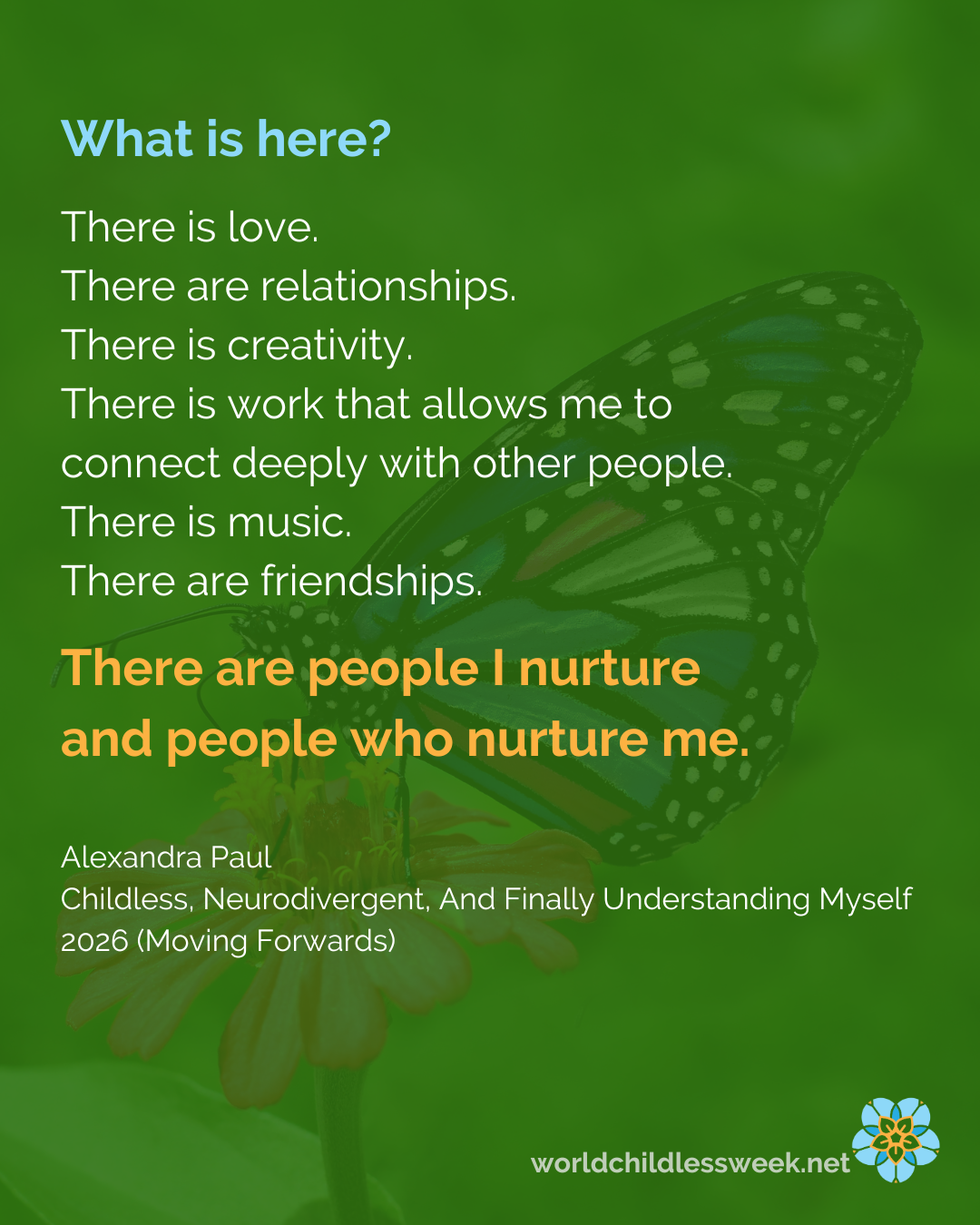
What is here?
There is love.
There are relationships.
There is creativity.
There is work that allows me to connect deeply with other people.
There is music.
There are friendships.
There are people I nurture and people who nurture me.
There is humour, curiosity and the ability — still — to become ridiculously excited about a new idea.
There is a life.
A full one.
Not full in spite of being childless.
Simply full in its own particular way.
Perhaps one of the unexpected gifts of getting older — and finally understanding my neurodivergence — is that I am becoming less interested in what my life was supposed to look like.
There is tremendous freedom in that.
We are given so many templates for adulthood.
Education. Career. Partner. Marriage. House. Children. Grandchildren.
And there is nothing wrong with that life.
It can be wonderful.
But it isn't the only life available.
Those of us whose lives move away from the expected route sometimes have to become cartographers.
We have to draw the map while we are travelling.
That can be frightening.
But it can also be liberating.
I don't have children.
That will always be part of my story, and sometimes there is sadness attached to it.
I was diagnosed with ADHD late.
That, too, will always carry sadness for the years when I didn't understand myself.
I don't think acceptance means reaching some magical point where either of those things stops hurting.
For me, perhaps acceptance is no longer requiring the pain to disappear before I allow myself to enjoy my life.
The sadness is allowed to sit alongside everything else.
Alongside gratitude.
Alongside laughter.
Alongside love.
Alongside plans I haven't made yet.
Childlessness doesn't mean that my life has been without nurturing, family, creativity, responsibility, love or legacy.
Those things have simply taken different forms.
And being diagnosed later in life doesn't give me the years back when I didn't understand myself.
I cannot go back and whisper into the ear of my younger self: There is a reason some of this feels so difficult.
I wish I could.
But perhaps I can do something for her now.
I can stop judging her.
I can recognise how hard she tried.
I can forgive some of the things she got wrong.
And I can live the rest of our life with considerably more kindness.
Diagnosis gives me a new way of understanding the years ahead.
I can stop spending quite so much energy trying to become the person I thought I was supposed to be and pay more attention to the person I actually am.
Perhaps that is where I am now.
Childless.
Neurodivergent.
Still occasionally grieving.
Still occasionally wondering what if?
Still capable of having seventeen ideas before breakfast and forgetting why I walked into the kitchen.
But increasingly comfortable with the fact that a meaningful life doesn't have to follow the expected script.
I’m not trying to rewrite the life I didn't have.
I'm learning to honour it, grieve it when I need to, and then return to the life that is actually here.
And I'm becoming much more curious about the life I still get to create.
And, knowing my ADHD brain, I imagine it will be interesting.