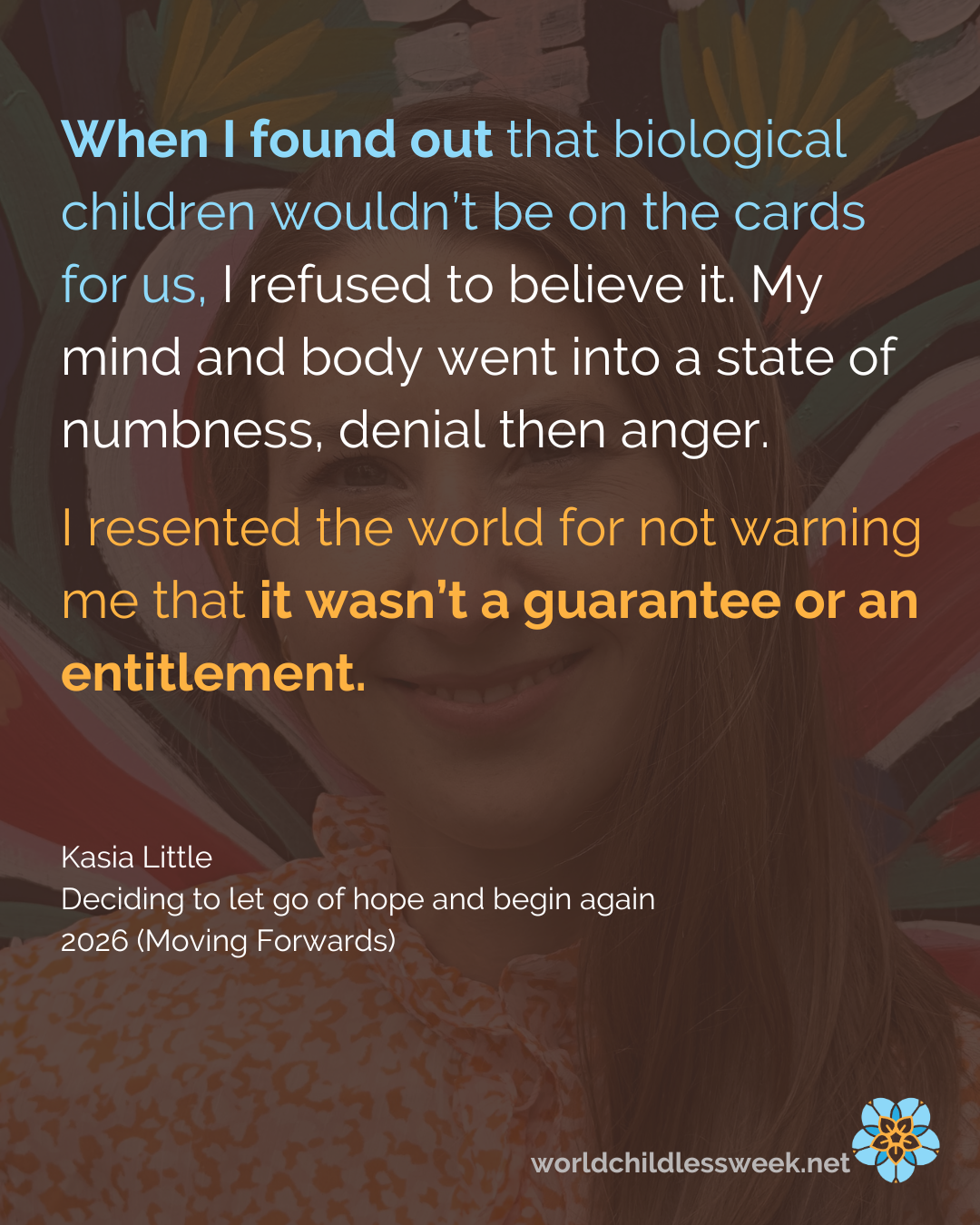
Kasia Little
When I found out that biological children wouldn’t be on the cards for us, I refused to believe it. My mind and body went into a state of numbness, denial then anger.
I resented the world for not warning me that it wasn’t a guarantee or an entitlement. For making me believe that IVF was the answer to all our problems. For making me fear pregnancy in my twenties and take preventative measures until the time was ‘right’. For the false narrative that childbearing years can comfortably extend into our late 30s and 40s without consequence.
I refused to believe that something so precious to me, something I had dreamed about for so many years – perhaps even since childhood – wasn’t going to become true, that childlessness would be my fate. I’d already been failed by medicine, so why should I listen to it now telling me this was the end of the road?
Hope became my lifeline, and I gripped onto it even as it dwindled. But what I didn’t know then was that it would also become my captor.
So, the tracking, testing and timing continued. Every month, every cycle, was a chance that couldn’t be wasted. And it went on like that for another year-and-a-half.
Meanwhile, I remained in a job I had long since fallen out of love with. One that was no longer fulfilling me but draining me. It wasn’t difficult and I was good at it. But pretending I enjoyed it and forcing myself to show up and put on a performance day in day out was exhausting. What made it worse, was there was nothing in the remains of the day to balance out the frustration. And I was tired. So, so tired.
But the sensible choice was to stay put; there was stability, a great maternity package, enough income to support nursery fees. I’ll admit it, I stayed for the money and the security.
And that was my undoing.
Because I wasn’t just in the process of losing my identity as the mother I always thought I’d be. I was also losing my sense of purpose and the parts of me that existed long before and alongside that identity.What seemed like a sensible choice at the time turned out to be another enormous personal cost.
Who knows how long I would have gone on like that if it hadn’t been for a brief natural pregnancy of ‘unknown location’.
For a short time, I saw it as the evidence I’d been looking for that medicine was wrong. That we could do it. That the hope I had clung to was worth it. But losing that little shoot of hope also forced me to confront the toll it had taken on me.
For years, the cost of not trying, not pursuing fertility treatment, not hoping, not believing, felt greater than the cost of carrying on. I was willing to accept the demand on my physical and mental energy. The transactional nature of intimacy. The constant waiting. The pause on other important aspects of life and identity. All of that felt worth it because there was still a possibility.
But with this brief pregnancy came the indescribable pain of being cruelly given a glimpse of possibility, only to have it snatched away. It became too much for me to want to bear again.
Hope was no longer my lifeline. It had become my anchor, keeping me stuck in a place of perpetual pain and effort, with no end in sight.
Knowing it was time to let go
There is a question many of us facing childlessness wrestle with:
“When is the right time to stop?”
When do you stop fertility treatment? Stop trying? Stop hoping?
For me, I knew the time was right when the cost of carrying on became far greater than the cost of letting go.
Believe me, that realisation didn’t come easily. And it wasn’t a simple calculation. I fought against the sense that stopping meant giving up. That I was failing. That I was incapable of doing the most natural thing in the world.
But when I was trying to make sense of it, I found it helpful to try and step outside the emotion for a moment and look at the decision from every angle; to see the costs and the consequences of each option in full.
So I asked myself these four questions:
1. What will happen if we decide to end the journey here?
2. What won’t happen if we decide to end the journey here?
3. What will happen if we decide not to end the journey here?
4. What won’t happen if we decide not to end the journey here?
Some of them might seem like similar questions, but you’d be surprised what they surface.
I mapped the answers out into four boxes (I’m a very visual person you see):

It was surprisingly powerful.
Because when you’re caught in the middle of something so enormous and emotionally charged, it can be easy to focus only on what you might lose by stopping. What you might regret. What might still happen if you carry on.
Looking at all four questions forced me to consider the other side too.
What was carrying on costing me?
What was I putting on hold?
What parts of my life was I sacrificing?
What would I regain if I stopped?
And what would I have to grieve?
There were no easy answers. But seeing the whole picture helped me get clearer on what I was, and wasn’t, willing to accept.
If you are at this point yourself, I hope these questions might help you too. There is no ‘right’ answer hidden in them. They are simply a way of giving yourself the space to look at the situation holistically rather than from the perspective of hope or fear alone.
And if the decision to move forward is one you made long ago, you may still wish to go through the thought exercise. The beauty of it is you can adapt the questions to apply to many different decisions or indeed check back in with yourself.
The funny thing about making decisions, as I recently discovered myself, is that the act of making them can sometimes surface unexpected realisations about what you really want, not necessarily what appears logical.
So, whatever you may take from this exercise, do remember there is no ‘right’ answer or anything you ‘should’ do. Even if your decision appears to defy logic, the only thing that matters is what feels most right for you (or you both) at this moment in your journey.