Frankie Hockham
From a young age, I always knew I wanted to be a mum.
When we were asked about our future careers at school, my sister said she wanted to be a lawyer. I am incredibly proud that she achieved her dream. My answer was simpler: I wanted to be a mum.
I began trying for a family in my early twenties. After four years without a pregnancy, I was referred for fertility treatment, but the relationship ended soon afterwards. Looking back, it was a lucky escape, but it was also the first time I realised that becoming a mum might not be as easy as I had always assumed.
At school, we are constantly warned how easy it is to get pregnant. Nobody prepares us for the possibility that it may be difficult or may never happen at all.
In 2011, I met my now husband, Ross. From our first date, I was honest that having children might be difficult for me. Thankfully, it did not scare him away.
I had PMOS and knew conceiving might be a challenge. At first, we tried to stay relaxed. We would enjoy our life, try for a baby and see what happened.
But month after month, nothing happened.
Soon, our lives filled with medication, scans, blood tests and hospital appointments. Some treatments made me so unwell that I went to work carrying a sick bag, mints and ginger biscuits. Other treatments gave us hope, only for that hope to disappear again.
Eventually, we were referred for IVF.
Our first cycle was cancelled. During the next, we produced a large number of eggs, but I developed ovarian hyperstimulation, so all our embryos had to be frozen. When we finally had a transfer, it failed.
After more than a year of injections, procedures and emotional highs and lows, we thought we had reached the end. Then, after some time to recover, we decided on one final attempt.
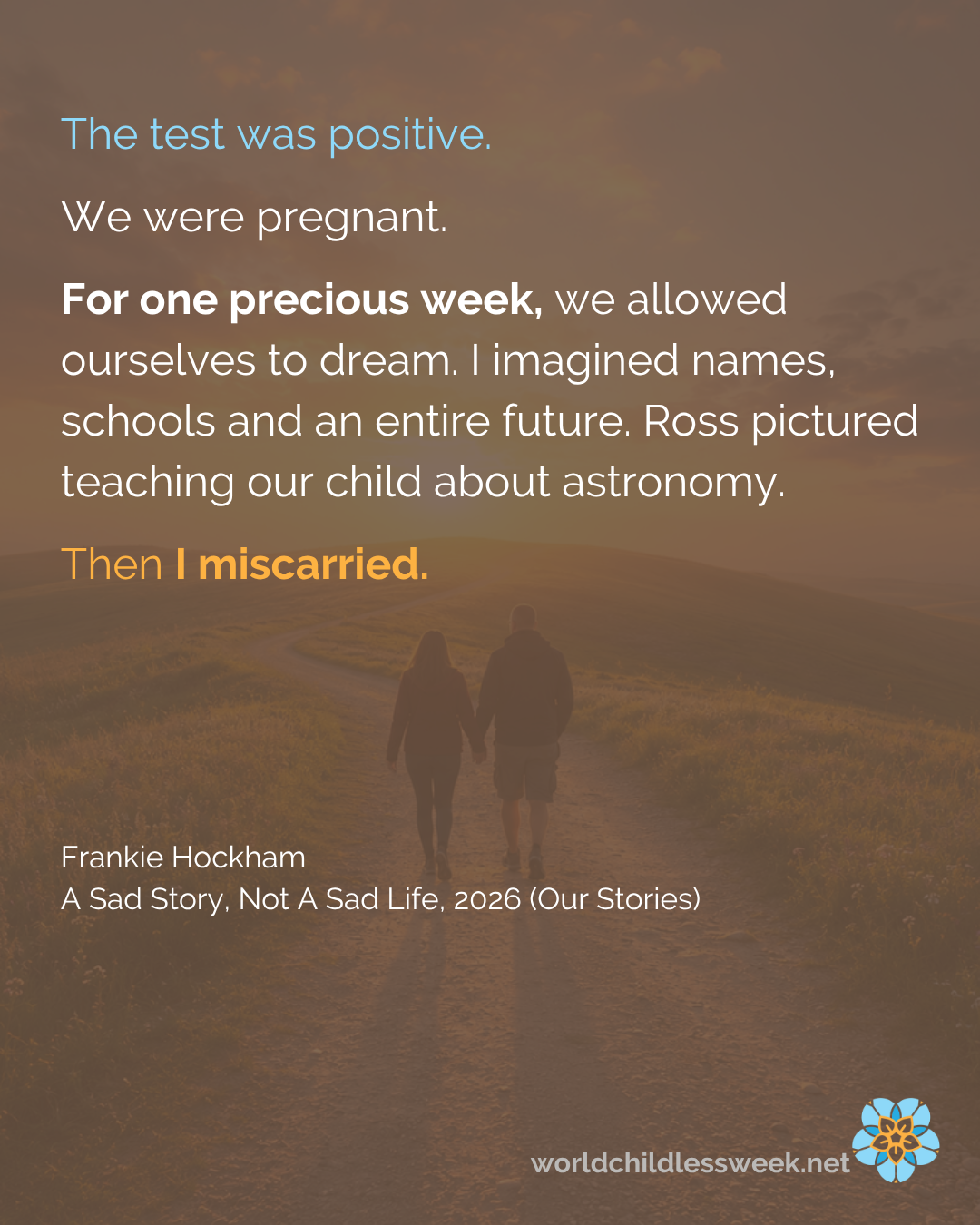
The test was positive.
We were pregnant.
For one precious week, we allowed ourselves to dream. I imagined names, schools and an entire future. Ross pictured teaching our child about astronomy.
Then I miscarried.
Afterwards, surgery revealed severe endometriosis. What should have been a short procedure became hours of separating my bowel from my womb. There was more pain, more recovery and more uncertainty.
Two years later, I became pregnant unexpectedly.
I miscarried again.
That loss was especially hard. I had begun to accept a childless life, and suddenly hope returned, only to be taken away once more.
Childlessness has shaped me. It has brought pain, loneliness, jealousy, anger and a grief that is often invisible to other people. I have grieved our pregnancies, but I have also grieved the child I imagined, the mother I expected to become and the future I had planned since childhood.
There are no rituals for grieving a life that was imagined but never lived. People may tell you to move on, be grateful for what you have or stop dwelling on what you have lost. They do not always understand that it is possible to miss someone you never had the chance to meet.
We also live in a world that treats parenthood as the natural next step and the centre of adult life. Childless people can be made to feel incomplete, as though our lives matter less because they followed a different path.
That is one of the cruellest effects of pronatalism. It does not simply celebrate parents and children. It can erase those of us who desperately wanted that life and could not have it.
But childlessness has not taken everything from us.
Ross and I are still the “Happy Hockhams”. We laugh, smile and turn negatives into something positive, even when that is difficult.
Our astronomy charity has become our baby in many ways, giving us the opportunity to inspire children every day. I also advocate for and support others who have faced similar experiences, helping them to feel seen, heard and less alone.
We did not become parents in the way we dreamed, but love, care and nurturing still run through our lives.
I once read someone describe themselves as having a sad story, but not a sad life. That stayed with me because it expresses exactly how I feel.
Parts of my story are deeply sad. There are losses I will always carry, and moments when the life I imagined still feels painfully close.
But my life itself is not sad.
It is full of love, laughter, friendship, purpose and adventure. It contains work that matters to us, people we care about and experiences we might never have discovered had life followed the path we originally planned.
This is not the life I imagined when I was a little girl.
But that does not mean it is not a great life.