Amanda Simmonds Screech
How often do we think about women who may have wanted children but due to circumstances beyond their control were unable to have them? And how might it feel for these women to live in a society where motherhood and family life are generally seen as the default?
My recent research,‘Do you have children – and what to say if you don’t? How do individuals who are involuntarily childless experience social discourse surrounding normative family life?’ explored how involuntarily childless women made sense of their lives in a world where their stories are often overlooked.
I was particularly interested in the common small talk question - do you have children?- which rather than being a social icebreaker, is a constant reminder of what’s missing, and what others expect.
The research reveals how painful life paths and awkward social moments shaped by cultural expectations around motherhood are being challenged by women who are reclaiming identity and purpose beyond parenthood and showing it's time our conversations reflected that.
Previous research
Around 1 in 5 women in Europe are childless – a trend that's reflected globally. Research into both voluntary and involuntary childlessness has been growing, and more recently has broadened to include how childlessness affects relationships, identity, and cultural expectations around motherhood – also known as pronatalism.
But what’s still missing is an understanding of how everyday conversations – with friends, family, or colleagues – shape the experience of involuntarily childless women. How does the language we use affect how these women see themselves and are seen by others?
The Research
My research was based on the interviews of 14 women over the age of 45. Most had been married (including one in a same-sex marriage), and while some had faced fertility issues, many were childless because of things like illness, timing, or not finding the right partner.
The highlights of the results can be found below, and the full report will be available later in the year.
What I discovered
My research brought to light four major themes:
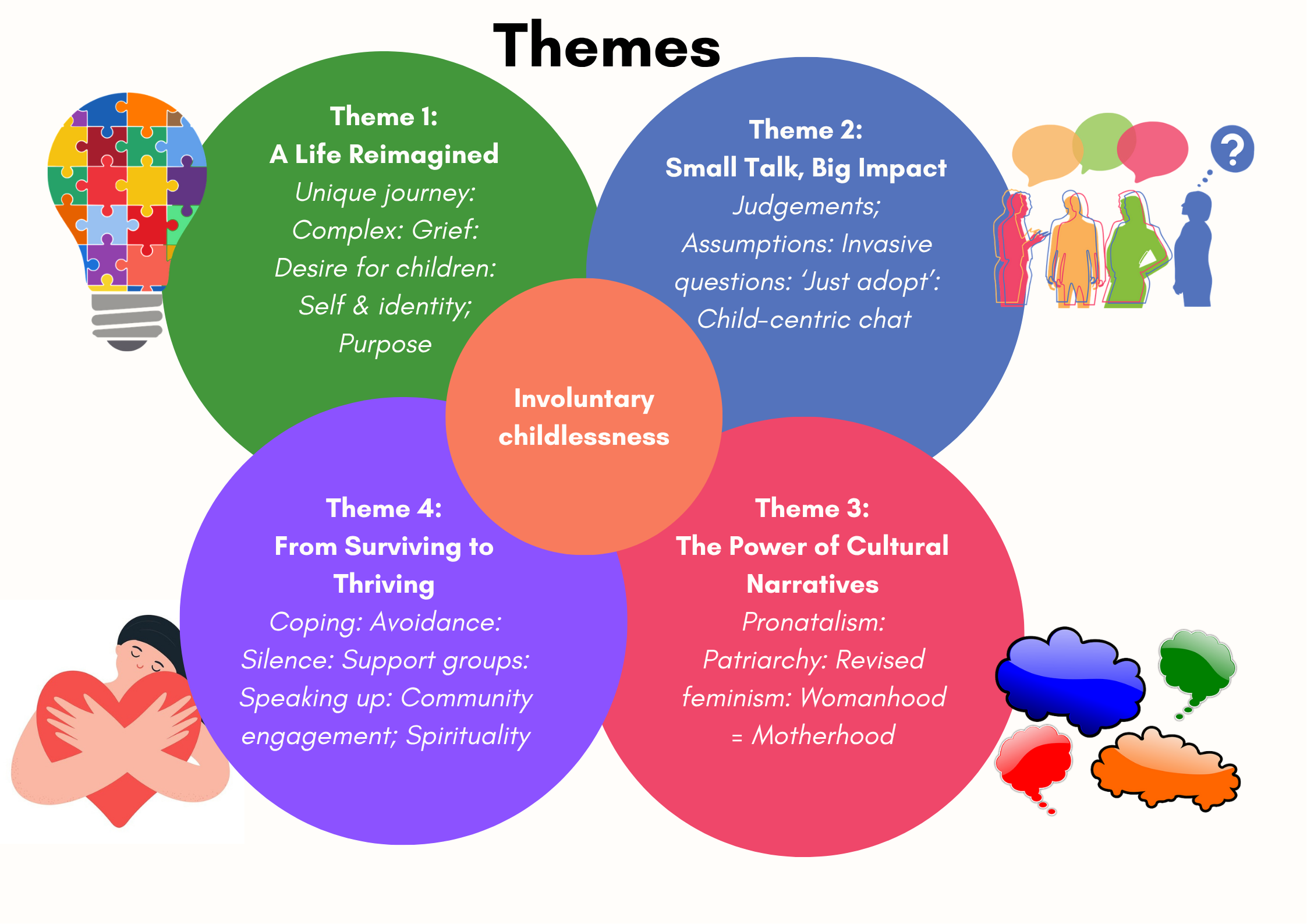
Summary of Results
A Life Reimagined – exploring involuntary childlessness
Involuntary childlessness is a life path few choose, but many find themselves navigating – it wasn’t a single moment or decision that led the women here – it was a culmination of circumstances, often beyond their control. While some have found peace, for many the journey is lifelong, filled with grief, reflection, and a search for meaning.
This doesn’t stop when you stop trying…this will be with you for the rest of your life
Every experience is unique
The women described diverse, complex journeys, some always wanting children, devastated when they didn’t arrive, others were more conflicted over their desires to be a mother, challenging the idea that all women want children all of the time.
Redefining Identity and Purpose
Childlessness challenged participants to redefine their sense of self. Without society’s ready-made scripts, they had to forge their own paths. Labels like “childless” or “childfree” didn’t fit, feeling too fixed or limiting. For some creativity, spirituality, or community engagement became new sources of identity. Many found meaning in what they could give, reclaiming maternal energy in ways that nurtured both themselves and others, showing that life can be lived fully in ways beyond having biological children.
Small Talk. Big Impact
Casual conversations often had deep emotional consequences. The simple question ‘Do you have children?’ could trigger shame, grief, or frustration. The women regularly faced judgement, assumptions, and invasive questioning, frequently having to justify or account for their situation. Adoption was also consistently suggested as a fix for their circumstances, an assumption that minimised the grief and complexity surrounding fertility loss.
They say I have it easy, but they don’t see the suffering
Silenced and Stereotyped
The study revealed a deep silence surrounding the subject, where childless women can be stereotyped, pitied, or excluded, regularly having to manage awkwardness in conversations when their childlessness came to light. Participants felt side-lined in what felt like a child-centric world, where in families, workplaces and friendship circles, conversations often revolved around parenting milestones.
Invisible Grief
Many described a profound, unacknowledged grief, not just for a child, but for a future life imagined and lost. Without societal rituals or recognition in discussions with friends and family, their mourning often felt invisible. Painful exchanges were common, with assumptions made of grief not being valid for something they had never had, deepening feelings of alienation and dismissal.
The Power of Cultural Narratives
The research highlights that womanhood and femininity appear firmly aligned with motherhood, shaped by societal norms and personal beliefs. This was primarily felt to be the influence of patriarchal structures and pronatalism, where having children is positioned as ‘normal’ and highly valued.
If we want to change the wider world, we need to be brave sharing, because we will always be misunderstood until the voices out there are stronger
Media complicity
The media and social media were seen as perpetuating idealised versions of motherhood whilst marginalising or stereotyping childless women. ‘Miracle Baby’ stories were described as particularly damaging, promoting false hope that success is always ultimately available. The women also shared examples of where friends with children had questioned their own decisions to become parents but felt too afraid to share these feelings more openly, reinforcing the power of society’s approach to motherhood.
Feminism’s Blind Spots
There was a criticism of feminism, which participants believed still focused on reproductive choice and agency, rather than encompassing the experiences of those who had no choice over their childless status. This included the commoditisation of fertility and IVF within feminist narratives, sold as empowerment. Particularly difficult was the promotion of the idea that ‘women can have it all’, which was felt not to reflect the realities of all women.
From Surviving to Thriving
Despite it all, the women had found ways to heal and, in many cases, thrive. Several were advocates for childless women, finding pride and purpose from their circumstances. Although several expressed that withdrawal had at times been helpful in self-protection, increasingly there was a desire to speak up and be heard.
In my company of over 20,000 people, I’m the only one speaking out about this… but I think I still have to keep trying
Strength in Numbers
Strength came from support groups that provided a sense of belonging and helped women express their experiences. In particular, groups such as Gateway Women, More to Life (part of the Fertility Network) and Ageing without Children offered a lifeline, with participants describing the transformative power of meeting others who truly understood.
Rewriting the Story
One of the greatest shifts came when the women found their voice. Whether talking openly about childlessness or writing about their experiences, shame turned to empowerment. While stigma still exists, the desire to challenge the silence and shift the narrative is growing. Continued research was felt to be an important step in educating the wider population on the realities of fertility as well as offering alternative and purposeful life paths for young people devoid of whether that involved children.
Personal Growth
For several of the women, having a spiritual or philosophical perspective provided a supportive lens for reframing their experiences. They spoke of healing trauma, embracing their own maternal energy, exploring creativity separate from biological reproduction and stepping into roles of elder or guide. They affirmed that motherhood was not the only path to legacy, nor the only measure of love, contribution, or feminine power.
Conclusion
The stories shared in the research reflect not a deficit but a richness of experience. Despite the painful journeys, there are expressions of resilience, growth, and transformation. The women may not have birthed children, but have birthed ideas, communities, and themselves in new ways. Their voices are powerful, challenging dominant messages that sees womanhood solely equated with motherhood, and show how identity, purpose, and agency can be reclaimed. Rather than staying silent, these women are choosing to speak out, and by doing so, they’re not only processing grief and loss but transforming it into something meaningful.
Ultimately, this is about more than childlessness, it’s about our ability to define ourselves on our own terms, finding meaning and fulfilment, even when life doesn’t turn out how we expected. We all feel different in our own way, and that should be celebrated and included. It is time to widen the conversation and to realise that sometimes the most powerful stories are the ones that challenge the script altogether.
If you are interested in more detail, please contact me at asimmondsscreech@gmail.com.