Yvonne John
World Childless Week Ambassador
Crossing Oceans
The 22 June marked Windrush Day. My parents crossed an ocean in their twenties, travelling at different times on the ship Irpinia in the 1960s. They were two people who packed up whatever they could carry and arrived in England believing, because they had to believe it, that something better was waiting on the other side.
I sometimes think about that crossing. Not the romantic version, but the version about the cold they weren’t prepared for, the doors that closed in their faces, the dignity they held onto anyway in a country that made it clear, in a hundred small ways, that they weren’t entirely welcome.
My dad has always been clear about what he wanted us to carry forward. Be strong. Be different. Show them you are better than they think you are. Get educated. Get a good job. Save. Buy a house. HAVE A FAMILY. I got the sense that no matter what, having children to continue our family line, to show what he had accomplished by coming to England, was of the utmost importance after getting educated and getting a “good” job, of course.
He said it in different ways, at different times, but the message underneath never changed: don’t let this country diminish you. Don’t shrink. Stand tall. Be proud of who you are.
The Child Who Doesn’t Exist
For most of my life, I assumed I would be passing on his words to my children. Not just hearing them - relaying them. Carrying them forward to someone who would one day ask, Mummy, what was Grandad like when you were young? What was that thing he used to say?
That child doesn’t exist.
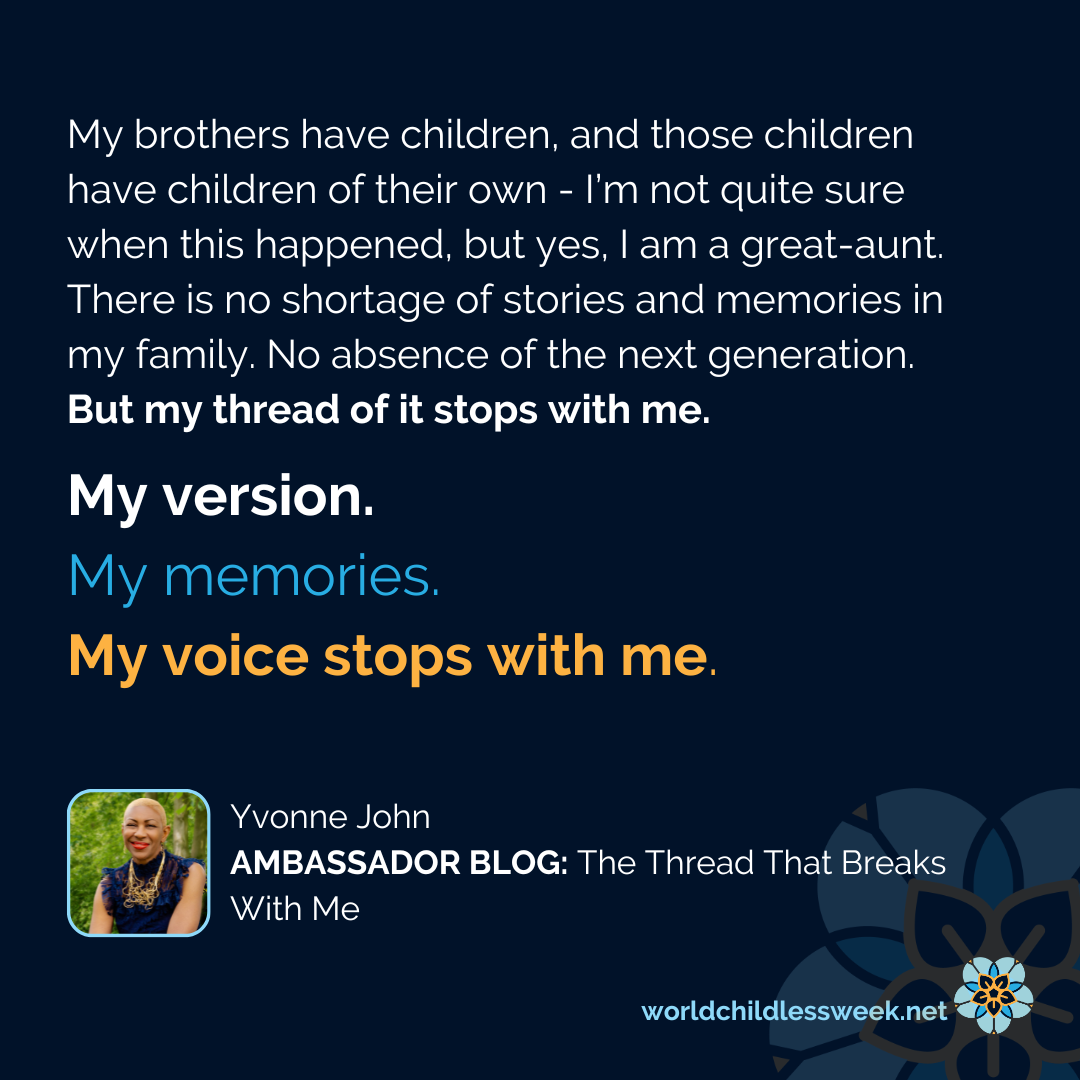
And that is its own particular kind of grief - quiet, easy to overlook, because nothing has technically been lost. My parents are here. The stories are intact. My brothers have children, and those children have children of their own - I’m not quite sure when this happened, but yes, I am a great-aunt. There is no shortage of stories and memories in my family. No absence of the next generation.
But my thread of it stops with me.
My version. My memories. My voice stops with me.
The Grief of a Broken Thread
I have sat with that fact for a long time.
It is strange to grieve something that, on paper, looks as though it is still fully there. Nobody sends a card for this. There’s no ritual, no language that quite fits. You learn to carry it privately, because explaining it out loud often invites the kind of confused sympathy that somehow makes it lonelier.
For a long time, I thought the grief was only about the absence of a child. It took longer to understand it was also about the absence of a particular kind of continuity - the sense that something of me, something of my children, something of my parents through me, would keep moving through the world after I’m gone, carried by someone who shared my blood and knew my voice.
What Windrush Knew About Legacy
I think about the Windrush generation when I sit with this, because they understood something about interrupted legacy long before I needed to understand it myself. They knew a life fully lived could be erased - from records, from rights, from the official version of history - as though it had never happened. They knew that what you pass on is never guaranteed. That the thread can be cut by forces entirely outside your control, no matter how carefully you’ve held it.
And still, they built something.
Still, something of them remains - in the country they reshaped simply by staying, in the children they raised to stand tall, in the very fact that I am here writing this because they refused to be erased.
The Legacy I Thought I Would Leave
I find myself returning to that when I consider my own circumstance.
The children I hoped for and didn’t have.
The conversations that will not happen the way I imagined them.
My dad’s voice, so present in my memory: “Be proud of who you are.” “You have to work twice as hard because you are a woman and you are Black.”
And no child of mine to carry those words, my wisdom, my tenacity, forward into a generation I will never meet. I don’t think that grief resolves. I don’t think it’s supposed to. But I have started to notice it changing shape.
Different Hands, Different Paths
What I have come to realise is that a thread doesn’t have to run through a child to keep moving.
It can run through the women I sit with and support in circles, who arrive carrying their own versions of this exact ache.
It can run through a book that finds someone at the right moment, the way a stranger’s words sometimes do.
It can run through a conversation that shifts how someone else carries their own inherited grief, long after I’ve forgotten I said it.
It can run through simply showing up fully in a life that insists on being lived anyway, rather than one organised around an absence.
It isn’t the legacy my parents pictured when they boarded that ship with everything they owned and nothing certain ahead of them. They imagined grandchildren who would grow up knowing the family’s story by heart.
That isn’t the shape it’s taken through me.
But I don’t think the shape has to match the original picture for it to still be a legacy. It still honours what they carried across that water - their refusal to disappear, their insistence on being known - even if it travels forward through different hands than the ones they were picturing.
Still Worth Building
I am still working out what it means to carry something forward when the motherhood path I expected is no longer there. I suspect I will be working it out for the rest of my life. But I no longer think the answer is nothing. I think it’s something quieter, less direct, and still worth building.