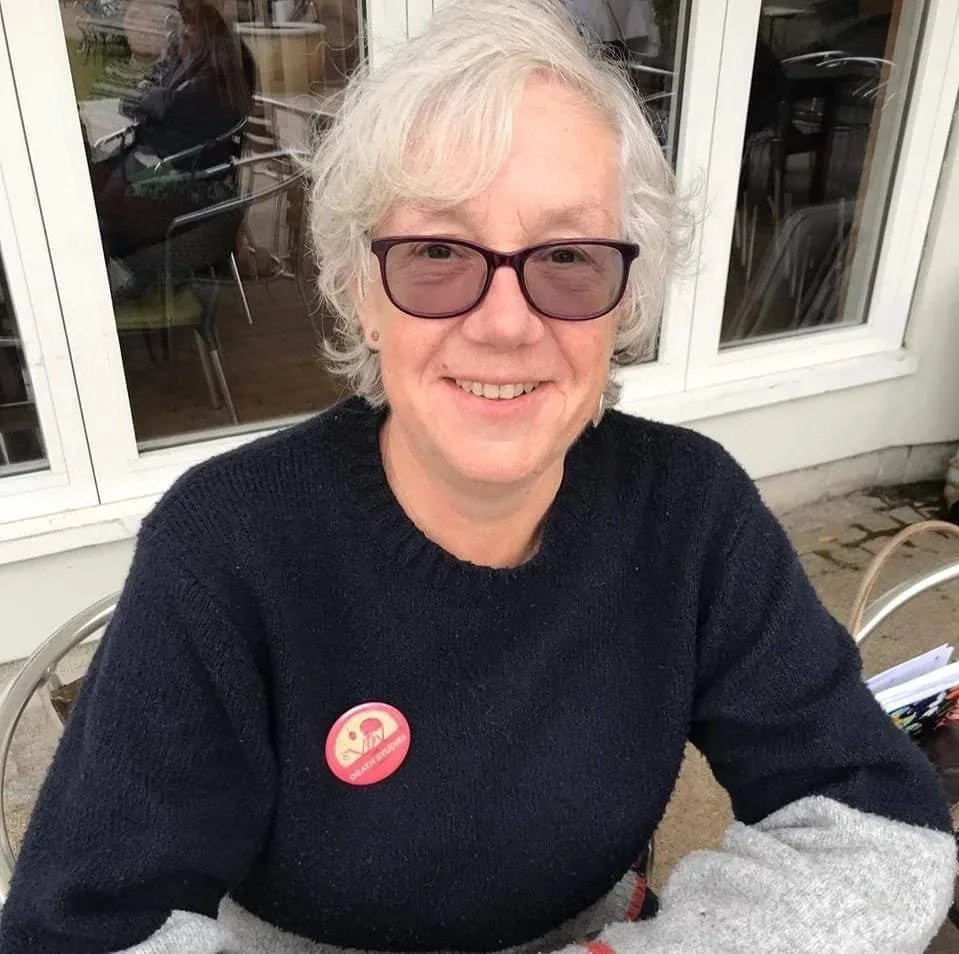
Gayle Letherby
World Childless Week Champion 2025/26
Much of my working life, as well as my personal life, has been spent reflecting on what it is like to be other than mother. I am a sociologist and over the last 35+ years I’ve been extremely fortunate to have had time and other resources to research and write about experiences that many people, including me, believe to be often misunderstood and misrepresented. This has included, but is not limited to, miscarriage and childlessness-not-by-choice, both of which are part of my own life story. This has extended to a broader interest in the status and experience of people who are, or have been, parents (either biologically and/or socially), and people who never are (by choice or not). All of these identities, I argue, are complex, may include feelings of ambivalence, and can change over time. And yet, in a world where pronatalist ideologies, that privilege and promote parenthood as natural and inevitable, are dominant, it is not that surprising that individuals without children are seen as ‘other’ with their identity often being thought of, discussed, and presented as one-dimensional. Research and autobiographical accounts contest that whilst women and men who are unable to have children often feel pitied by others those that decide not to become parents are often stereotyped as selfish. As I have argued for many, many, years such labelling is simplistic and offensive for the reality of ‘living without children’ just like life as mother or father, is always more complicated in reality.
The only words to describe a person who does not mother or father is in reference to what they do not have: not mother / not father; nonmother / nonfather; childless; childfree; all of which position the bearer as different, as missing something, as other’. Such descriptions are reductionist, and often an inaccurate depiction of actual experience, given that may people who do not parent children have roles such as godparent/guardian, aunt or uncle, friend, teacher, social worker, healthcare professional and so on. For this reason I often write ‘childless’ and ‘childfree’ in scare quotes. Despite this, and as others have pointed out, many people still feel that is perfectly acceptable to say and/or write ‘As a mother’, ‘As a grandfather’, in preface to personally perceived political and moral pronouncements. This naming of a grand/parental status, comparable with the oft heard ‘You wouldn’t understand you don’t have any children’, holds the unspoken but implied implication that the narrator is suggesting; ‘I feel more’, ‘I understand more’, ‘I am more’ ….
There are other ways in which language and discourse, informed by pronatalist expectations, excludes those without children, and I can recall many distressing and exclusory comments from acquaintances, colleagues, healthcare professionals, even friends and family. When in my late twenties, having already experienced a miscarriage and an inability to conceive again, and on replying ‘No’ to the question ‘Do you have any children?’ by a newish friend, I was told ‘You’ll regret it if you don’t you know’. This was after I’d been told by a doctor, that I could consider infertility treatment but in his view I probably didn’t want to ‘Go that far’. Much more recently in response to the ‘Do you have any grandchildren Gayle?’, I replied, ‘No, no grandchildren or children’, and was authoritatively informed ‘Oh, a nice easy life then.’ Writing this I am reminded of another doctor who on finding out during a GP appointment about something completely different that I had no children, ‘reassured’ me by saying; ‘You’re lucky, I’ve got four!’ And then there was the long-time friend who said ‘I thought you’d be over that by now’, when I spoke of my continuing grief surrounding both my pregnancy loss and my childlessness. I could go on and I’m know that any childless-not-by choice person reading this will have other examples to share.
My own experience, and my research on reproductive loss and reproductive disruption, have, I accept, made me hyper-sensitive to crass, stereotypical, simplistic portrayals. Yet, I don’t think I’m exaggerating when I suggest that cultural depictions of women who do not mother and men who do not father children (especially in biological relationships) still often draw on oversimplified caricatures. What makes it worse I think is that in many dramas and films, and with particular reference to the childless-not-by-choice, we seem to have moved on from pity as the ‘childless’ are depicted as not only lesser but as a danger to themselves and to others.
I was excited, and initially gripped by, Channel 4’s depiction of The Handmaid’s Tale. I had read the original book written by Margaret Atwood (1985) many years earlier. At around the same time I also watched the second series of Top of the Lake (China Girl). In both the TV versions of The Handmaid’s Tale and China Girl the themes of sexual and reproductive violence and exploitation are centre stage. Also highlighted, I think, were the differences between women who mother children and women who do not and women who are able to bear and give birth to children and women who can not. All the women in The Handmaid’s Tale – the handmaid’s, the wives, the Martha’s (servants), even the aunts (who train and have considerable power over the handmaids) – are victims within the ultra-religious, patriarchal Republic of Gilead (once the USA). Many of the women in China Girl whether (biological) mothers or not experience reproductive disruption and/or lack of control and some are abused and manipulated emotionally, materially and sexually. (The hero in each of these productions was played by the same actor Elizabeth Moss and both Offred (Handmaid’s Tale) and Detective Robin Griffin (China Girl) are mothers who (in different) ways have lost their daughter/had their daughter ‘taken from them’.) Yet, in each case there are subtle and not so subtle suggestions that biologically childless women are at best distressed and desperate, in need of pity and help, and at worst villains colluding with, even initiating, the exploitation of their sisters. There are plenty of other examples of similarly blatant othering of women who are unable to conceive or bear children. I recall, for example, an episode of the long running series Call the Midwife in which the woman, a mother herself, acting as surrogate for her ‘childless’ sister ended up keeping the baby as her sister could not cope when the child was born with a disability.
When I do read a book, or watch a film or TV programme, where the author seems to get it, or at least tries to, I rejoice, and there are some good examples out there. I read Sara Maitland’s Daughter of Jerusalem (1978) many years ago and was encouraged by the ambivalence that characterised the experience of the main character as well as by the acknowledgment that ‘resolution’ is not always easy or possible. Much more recently The Light Between Oceans (written by M.L Stedman, 2012) and You Are Here (written by David Nicholls, 2024) are much more thoughtful and holistic in their consideration of childlessness. I appreciate of course that others may not agree with my choices and have different hates and favourites.
What upsets me the most, and what connects the unthought-through grass statements and the lazy and simplistic (for dramatic effect) cultural descriptions is the lack of nuance, the denial of complexity in all people’s lives. What of the childless woman or man whose life is full of children, either through work or personal relationships? What of the mother or father estranged from their children or who have had their children taken away from them? What of those who move along, and possibly back across the continuum from childless-not-by-choice to childless-by-choice within a lifecourse? What of those who come to regret the choices they made to become parents?
The identities of the childless-not-by-choice are no less complex than anyone else. Like everyone, to different degrees our lives are a mixture of choice and chance; of things within and outside of our control. The experience of childlessness, just like the experience of parenthood, is an individual one and as well as there being things – emotions and experiences - that unite us there are differences too, between people and across one person’s life. My own story includes times of desperation, of feeling that I was a lesser human because of what I did not have, a lesser woman because of what my body could not do. The support of others (most specifically my mother Dorothy (who I truly believe I would not have survived without) and also friends and thoughtful colleagues); my work; the positive relationships I have with many children and younger people; and a great deal of personal reflection have all helped me to get where I am, to be who I am. In the last couple of years when asked to describe my feelings in relation to my (non)material identity I have said that I believe that it is possible to live with a loss and a sadness that never goes away and at the same time to live a joyous life. This is the case for me. I know that I am lucky to feel this way, and that for some the pain is always predominant.
My story, alongside those of many others in the World Childless Week community, represent a challenge to the stereotypes, to what everybody knows, or thinks they know about living a life that does not include mothering or fathering one’s own children (in either a biological or a social relationship). From my own experience and from all of my academic studies of reproductive loss and reproductive disruption I have come to realise the need to be disruptive. To name our experience in all its complexity; the pain and the possibilities, the ambivalence and the certainties, the changes and constants, the similarities and the differences between us…. When my own reproductive struggles began and when I first started to listen to the stories of others there were fewer spaces for challenges to be aired, few voices, less noise. That there is now so many more opportunities to speak out, to get support, to educate others, is heartening indeed. But, as all I have written here suggests, there is still so much more to do.
Let’s all continue to be disruptive together.