Julie McNevin
There are two questions raised in the topic description that resonated with me "Have you been made to feel like a fraud because “you don't look ill”? Has anyone dismissed your grief and implied you are childfree because they don’t understand you made the toughest of decisions?” The experiences, barriers and grief I experienced from non-motherhood/IC and infertility had long term and chronic consequences for my mental and physical health; some of which are not made explicit in the story as their are either still to painful to relive, I am uncomfortable with disclosure, or I wished to provoke a 'politics of wonder’. Over the last few years I have been on a journey to understand by experiences through my graduate studies. I wish to extend my gratitude to the amazing faculty who have been supporting this journey.
My submission is a short story and reflection that was written for a recent graduate course assignment. The course was a Disabilities Studies offering through the Social Justice Education Department at the Ontario Institute for Studies in Education (OISE) at the University of Toronto, Ontario, Canada. A central goal of the course was to explore disability (especially blindness) and examine how perception is formed and performed through cultural practices and processes. For this assignment we were asked to compose a short story that would explore how blindness as perception might reorient how an issue is encountered, understood, or lived. The reflection required engagement with course readings and the “Blind Spots” that had guided lectures and seminar discussions.
How shall we begin? Or perhaps the question should be, where shall we go?
Let’s go back to January 8, 2023. My new museum manager has just emailed me a list of initiatives that I’ll be expected to execute, which will significantly add to my workload. Certain new priorities, requiring immediate planning, include mommy-and-me activities, Family Day programming, and a Mother’s Day high tea.
I was working from home when I received the email. Without much thought at all, I stood up, swiftly retreated down my hallway into my bedroom, climbed into bed, pulled the covers over my head, and broke down into tears. I lacked clarity over the impulse of this movement but was consumed by it. My body shook uncontrollably as I wept and wailed into my pillow.
The feeling of losing my connection to and passion for my work was terrifying and crushing.
Everything I do isn’t good enough. I thought.
I’m becoming unreliable.
They can replace me in a heartbeat.
The gap between lists of expectations and the capacity for performance had become a cavernous void I could not fix. The burnout and cruel estrangement from something I had worked so hard to build was deeply unsettling.
I laid there balled up for a while and my mind started racing, perhaps in an effort to enclose the chaos unfolding.
Maybe I should tell her these programs are hard for me to do right now, I wondered.
No, no…bad idea…you will just make it messy, awkward, and uncomfortable…you can’t, was the immediate after-thought.
No, she wants productivity and boxes checked and has no time of day for your personal hot mess. You can’t falter. You’ll blow up your whole career.
Marinating in my own thoughts, I reached the conclusion that disclosure and advocacy would just make things worse, and it was my burden to carry. To try to explain something I didn’t even understand— that I didn’t have the language or words for— would be an inconvenience and mark me as insubordinate and non-compliant.
An in-person meeting was scheduled to occur in two days, which would be the first time meeting her face-to-face.
As the handle to my office door turns, and the latch clicks, and my shoulders immediately became tense with worry. I watch the door swing open and she walks in, visibly well into a pregnancy. I uncomfortably shifted my line of sight, moving between objects and various focal points in the room, trying to avoid looking at her baby bump.
“You, uh, wanted to talk to me about some programs,” I said somewhat nervously. I had hoped that this would pre-empt any personal small talk.
“Yes, I want to get as many things set in motion before my maternity leave as possible,” she states firmly.
Fighting through an emerging lump in my throat, I muster, “Right, so…um…here’s the thing…I’m a bit behind on my planning for the year. I know that’s not what you want to hear.”
She shifted in her seat and said with a prideful grin, “Oh, well…we really need to get moving and I have a bunch of things already planned out.”
She ran her hand over her bump as she referenced the strategic plan, expectations from senior management, and the timing of her maternity leave. I glanced at my list of points, but my mind was going blank. Part of me was already well-distracted trying to manage my emotions; occupied by an intense inner conflict between fight, flight and freeze. The directives were enthusiastically firm, decisive, and certain. The message was clear—perform. Any hesitation or resistance on my part seemed invalid. And so, I withdrew my list of concerns and descended into liminality.
As she begins to make her exit, tears start to build up along the ridge of my lower eye lids as a shame storm made of sadness, fear, and anger gathers in my chest and throat. An armouring breath inwards choreographs the titling back of the head, raising my chin up and out towards the ceiling. Teeth press together and a firm swallow serves to sandbag the tears.
Not now. Be professional. Come on, get it together, I tell myself silently.
Yet, I could not seem to escape the feeling that everything was catching up with me, and I wasn’t tough enough to cope. The truth is, I had been carrying a profound and painful secret. One that felt unsafe to reveal, particularly to my colleagues. It was getting too heavy to carry and pretend I was okay.
I moved through the rest of my shift, fighting the current of my emotions, and dodging as many conversations as possible. I try to distract myself with tasks on the computer and around the room, but my mind was in a fog and my body felt heavy, like it was moving through wet sand.
This is bad…it’s all falling apart…I’m falling apart, was a constant anxious thought.
I sat in my desk chair in a daze with nothing but the company of constant down draft of cold air from the ceiling vent, a ticking wall clock, pitted cinder-block walls, and the persistent glare of the fluorescent lights. The air was thick with a stagnant smell of musty books and artifacts.
I can’t breathe, move, or think here anymore. I can’t be here. I sensed it in my bones.
Five years of pills, needles, and scans. Test, upon test, upon test and a ticking clock. Procedure after procedure. Shrugged and puzzled shoulders. Dwindling savings and a body violated, marked, and scared by the exertion of reproductive technology and medical indifference.
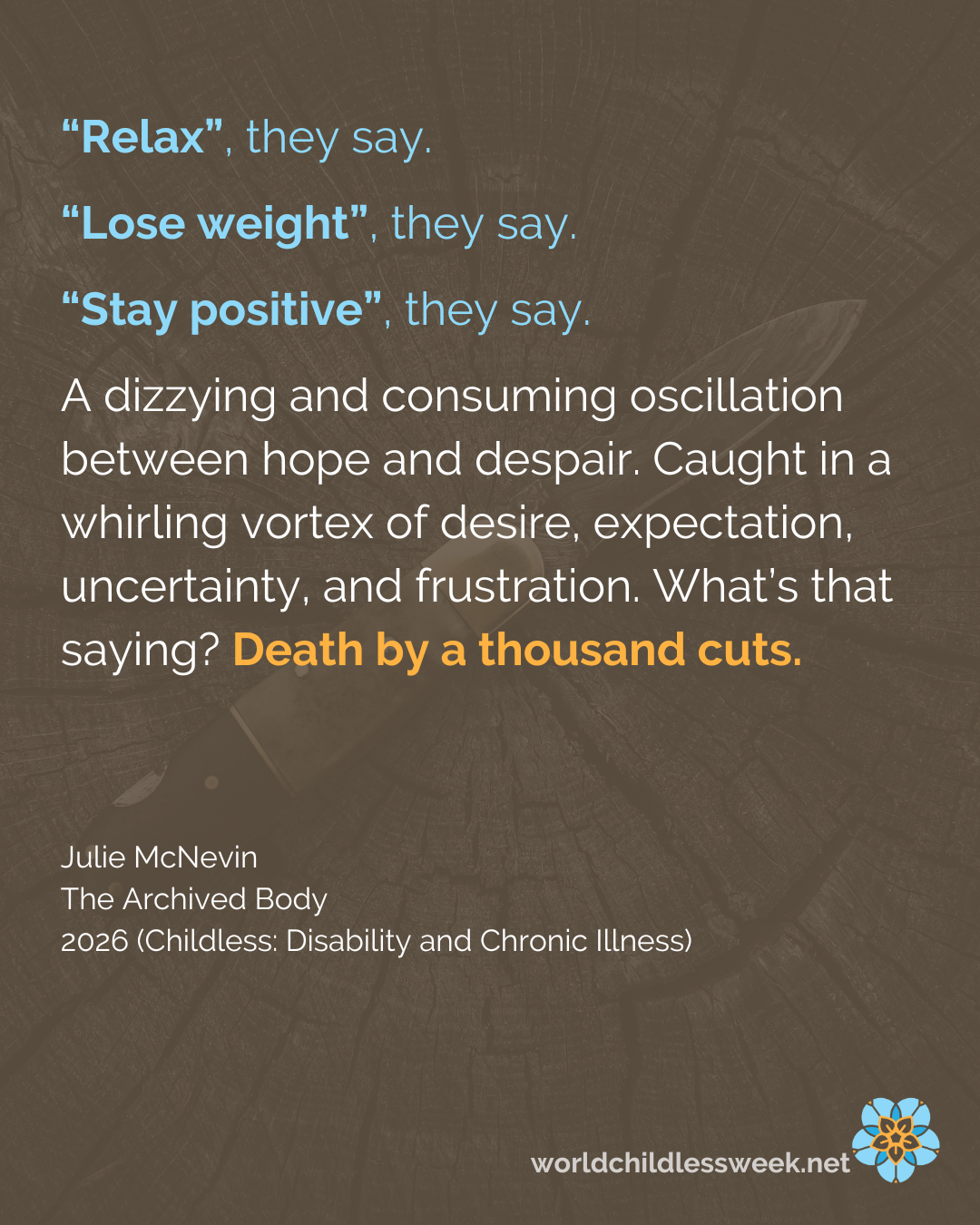
“Relax”, they say.
“Lose weight”, they say.
“Stay positive”, they say.
A dizzying and consuming oscillation between hope and despair. Caught in a whirling vortex of desire, expectation, uncertainty, and frustration. What’s that saying? Death by a thousand cuts. Am I allowed to call it trauma? Or is it merely weakness and disorder?
Sure, there was more to try. More science. More medicine, but the management of it no longer felt sustainable. It felt like it was slowly killing me. It came to a point where I felt there was no ‘more try’ in me to keep trying with. I reluctantly decided to cut my losses and ended my fertility journey; I suppose out of self-preservation. It felt selfish and the ‘what ifs’ followed me wherever I went.
There is always a reminder or an encounter to illicit a tug-of-war between distress and composure, often leaving a feeling of being pulled apart. As comments and opinions are made, my hands tighten and clench to steel me against the impact; a fingernail or two digging into my thumb to trigger a distracting pinch. Often, I close my eyes and hold in a deep breath, as if that will help me choke back the pain of another pregnancy announcement or an uninformed comment about IVF or adoption. Each encounter met with the intruding thought: It never ends.
The sting. The turmoil. The ache.
I didn’t know how to face, let alone deal with this confusing and layered sense of loss and otherness, let alone know how to explain it. Loss of what? A dream? A desire? A rite of passage? A legacy? Belonging? Sure. Followed by my confidence, self-trust, and vitality. There was the stark realization that I would never nurture and watch my children grow, but it was more than that. The love I longed to give to my child and the mother I could be if given the chance quietly eroded like a shoreline slipping into the water and disappearing below the surface, and with it, my sense of self and future self. I felt like such a failure and profoundly ashamed of both my shortcomings as a woman, wife, daughter, sister, aunt, colleague, employee, and friend. I hated the person it seemed to be turning me into—The killjoy.
I was caught off guard and unprepared for the fall out. It brought me to my knees on the edge of a barren and forsaken cliff, arms hanging down, empty with the weight of hopelessness across my lap. Palms turned open yearning for answers to explain, why me? And yet, I felt I had to dig deep and suck it up if I was to avoid anything else unravelling. For the sake of things like the stability of job, paying bills, and my reputation, what option was there except to learn how to become numb to it – to “handle it” and “get over it”. I didn’t think I had a choice. And so, without question, it continued—Armour. Smile. Perform.
One night I was awakened by a night terror and unable to return to sleep. I retreated to my basement living space, perhaps drawn there by the darkness and stillness it offered. I arrive to the space with a pressure in my chest, shoulders pinching inwards, struggling for the deep breath that might bring release. Headaches, muscle tension, and anxiety had become persistent and exhausting in their daily presence. I often felt dizzy, nauseous, ringing in my ears and like my heartrate was irregular. The ground beneath my feet felt unstable and like it might open up and swallow me.
What is going to happen to me? I wondered.
Laying on the floor offers a comforting firmness that seems preferential to the cushion of a chair. The initial breaths are shallow and strained. Weary eyes close into an inward focus. A rolling back of the shoulder blades, pressing them into the floor, and opening the chest. Muscles from head-to-toe contract and are held in unified tension before a melting release. This movement is repeated several times until a semblance of abatement ascends. A deep inhale through the nose, and in the moment before just before the exhale, the hand is called to place over the heart, pressing down into the chest. Fingertips tightening and curling inward, attempting to touch and ease the tension. Pressing in and upwards ushers a sensing of the void, a yearning to feel at peace, and a profound ache that resides deep within the soul. Cool tears stream down the face, and the body shakes in anguish.
November 2025. I’ve invested a lot into remolding and reorienting myself in the aftermath of my infertility journey, and to come to terms with involuntary childlessness. There really is no road map, or at least not one that I can read. I left my job in July of 2023. Within a few months, I had taken on temporary museum work elsewhere, started my small crafting business, got hired as a course instructor, applied and was accepted to grad school. Plenty was happening, but something still seemed unresolved within me.
How can this be? There must be something wrong with me. Am I defective or broken? I pondered endlessly. Something has got to give.
Clearly redirecting my labour, new surroundings, new colleagues, diving into hobbies, and surface-level calming strategies were only a temporary solution.
It gradually occurred to me, through my ponderings, therapy, research, and writing that I was never going find the answers I’m looking for outside of myself. My self isn’t out there. I was going to have to turn inward and attend to the shadows of my being that had been buried and vaulted away. My body was trying to name a need my conscious mind could not, or would not, and was asking not for mere alleviation, but to be permitted care. I needed to go in…way in…I needed to drop into my body.
As I mustered courage and resolve for the journey, I thought: Shit. I’m scared and I’m not sure I really know what to do, but I guess there is nothing to lose by trying, I thought as a fluttering and pulsing sensation ran through my legs and arms.
I quickly grabbed a journal and leafed towards a blank page sensing something was about to happen. I laid on the floor on my stomach in a prone position and closed my eyes, wresting my forehead in my crossed arms over the pages. I was nervous and unsure.
The first moments lingered on a felt sense that my voice doesn’t matter –That staying silent is safer and easier than having to strain to explain and risk being misunderstood, or risk deepening feelings of simultaneously being “too much” and “not enough”. I felt this as the usual tightening in my throat, shoulders, chest, and hips. My eyebrows and lips draw together in a reflexive flinch.
I persist in wading in further by following a deep breath through my nose. It took me down my throat and towards my heart. Another breath nudged me a little closer. This area feels tender, pitted, and bruised. I’m unsure what to do, but sense I need to go further. Another deep breath in and I travel down.
Am I exploring my body with my mind? I don’t know what I’m doing.
With another breath and I arrive at the tension in my hips, pelvis, and lower back.
Now what?...Hello?
There was a brief pause before an uneasy voice inside me spoke, “Please stop hating me so much, it hurts.”
A wave of emotions washed over me, conjuring immense and forceful tears, which immediately began to pour down my cheeks and onto the pages, causing the ink to run.
My body reminded me of its trying, but more importantly its doing – the things I craft and make with the movement of my body. Its efforts in these creations and work as a creator. It was suddenly so clear how deep and profound my self-abandonment was – how losses, fears and invalidations had twisted and turned into inward resentment and cruelty. How unsafe I had come to feel in my own body to the point of dissociation and neglect. I held myself tightly as I might a wounded child.
In this moment, I chose to let grief carve its path. To suspend knowing and listen, as compassionately as possible, to everything I had tried to suppress and avoid. To everything my body was holding and carrying for far too long. As I did, I took a deep and melting sigh of relief and felt my self re-emerging.
I never lost myself. I just hid parts of it away. Archived it. To protect it— as a mother might shelter her children from a storm. Or protect them from wolves.
It was trauma. It is trauma. And it is not my sole responsibility.
Reflection
This story is an auto-biographical work that represents a reflexive return to some pivotal moments in the early days of becoming involuntarily childless. This is the first time I have endeavoured to attend to my experiences through what I am going to call a somatic storying journey. This journey holds a mirror to the epistemological and ontological challenges related to infertility and involuntarily childless experiences, and experiments with their articulation. It is my hope that the story initiates questions of meaning regarding the complexity of agency, autonomy, silence, derealization, individualization, and the like, which can all benefit from an examination of unquestioned norms and uncertainty of access. Here I use ‘access’ in keeping with Tanya Titchkosky (2011), who states, “access is a way to orient to, and even come to wonder about, who, what, where, and when we find ourselves to be in social space” (p.3).
This journey prompted me to access my story in new ways, which I feel it is valuable for my personal growth, advocacy work and future research. My intention was to offer a glimpse of the ongoing organizing and reorganizing of the self and ways of being through dominant (yet often unacknowledged and unquestioned) cultural scripts. I was inspired by our first blind spot quote from Titchkosky (2011) who writes, “Coming face-to-face with questions of meaning requires not explanation, but rather explorations of that which grounds what is already said and already done” (p.15). Titchkosky (2011) adds further, “the certainty of knowledge regarding disability and access must be examined as a way to uncover how this certainty is produced and sustained” (p.15). These statements significantly informed the non-linear sequencing of the story as a strategy for opening a politics of wonder.
At the heart of this story, I feel, is the paradoxical tension between the individualization of infertility and childless journeys and the ways in which it is lived out (i.e. mediated) relationally. This opens a politics of wonder that requires a shift from questions of why am I struggling to self-advocate and why am I infertile or childless, to how did my world became less accessible, and how did I come to live outside of myself? This is the arena in which the complex layers of this experience might be made intelligible, challenged, and worked upon. As such, the story is not built around why childless grief or trauma exists, but rather how it is inhabited as a socially mediated and isolating experience.
There might be many questions that arise about why I did not speak up or advocate for myself. I often wonder myself, and as the story shows, was highly self-critical. Ace Lehner (2024), referencing the work of Judith Butler, wrote “how people embody norms is often intimately enmeshed with survival” (p.5). In my case, choices to avoid disclosure, mask how I was feeling, and perform ‘normalcy’ were often driven by shame, fear, and a perceived lack of safety. What I hope the story reveals is that this is not of my own making. Aspects of my experience involving disenfranchised grief, stigma, and shame are built and reinforced through the repetition and accumulation of relational exchanges that constrain agency and autonomy.
David Shulman (2017), explains that “people are expected to embody valued attributes when in front of people, or “onstage,” and they experience powerful social pressures to do so that impact their self-consciousness and affect how they interact with others” (p.6). My movements, whether withdrawing from self-advocacy, avoid excessive social interactions, and mourning in private were largely evoked by social pressures to manage impressions and act in line with standards of professionalism, authority structures, and respectability. Previous experiences in which I readily dismissed or side-stepped instinctually lead to the concealment of emotions to avoid deepening stigma, lack of belonging, or perceptions of ineptitude. This is the orienting power pre-existing “social conventions” at play (Shulman, 2017), and the work of culture (i.e. hustle culture, pro-natal culture, patriarchal culture, and ableism culture).
Devon Healey (2021) writes, “The stories we tell become the stories we live and the stories we live become performance of values and beliefs we often did not realize we possessed” (p.4). The story, while personal, reveals the social structuring of biographical or life course narratives about my career, motherhood, and a fulfilling life. I subscribed to the dominant societal values and scripts of womanhood, motherhood and professionalism because I was cultured to do so. When I could not fulfil my role(s), it became a profound biographical rupture and highly disorienting dilemma. Telling myself another story required exposing these beliefs and working to adjust my relationship to them.
Healey (2021) writes, “Stories of knowledge of the world told, heard, retold, and collected over time make up what we perceive to be expected, normal and unexpected, or not normal” (p.10). Conventional stories of gender roles, generational success, biographical fulfillment were part of my habitus and those around me. One of the reasons I chose my workplace setting is that it subtly and repetitively reinforced a habitus that demanded an unburdened “ideal worker” (Acker, 2012), or at the very least a ‘legitimate’ reason for being burdened. For me, this led to disenfranchised grief (Doka, 2017), emotion work (Hochschild, 2012), a fear of spoiled identity (Goffman, 1975). As Shulman (2017) explains, the social coordination of this is woven into everyday life and rarely questioned. My body, however, sensed the dissonance and was wounded by carrying the responsibility alone.
I greatly appreciate the work of Sara Ahmed (2006), who brilliantly shifts questions and explanations of ‘why’ to the realm of ‘how’ by conceptualizing norms as pathways to which we are directed to move in a particular direction, and stay in line with certain expectations. I had to find a way to step out of certain habits, routines, and surroundings to “think not only about what is repeated, but also about how the repetition of actions takes us in certain directions” (Ahmed, 2002, p.553). The interactions with my new manager came at a point when I was already struggling. It was all too easy for the usual “straightening devices” (Ahmed, 2002, p.562) to exert and reproduce their power unquestioned, reducing agency, and producing relational dissonance. The effect of trying to “inhabit the very place of this rejection” (Ahmed, 2006, p.568), was a world of isolation less accessible to healing, wellbeing, and joy.
Tanya Titchkosky’s term ‘half-and-half’ also offers helpful framing. She writes that half-and-half is “a metaphoric way to refer to being guided by the understanding that we are both apart from and a part of that which makes us: culture” (Titchkosky, 2011, p.21). I believe the half-and-half concept can apply to the ways in which I came to inhabit my infertility and childlessness. I feel a strange paradox occurred from attempting to ‘act normal’ and retain a sense of wholeness or composure amidst disenfranchised grief and the pressures of “bureaucratic linear time” (Titchkosky, 2011, p.21). It actually led me to split myself into public and private lives and produced a very challenging and confusing feeling of being “half in and half out” or “a part of and apart from” (Titchkosky, 2011, p.21). This made it hard to know where I stood in any given moment and how to proceed. I feel this is precisely what produces a “crisis of belonging” (Titchkosky, 2011, p.23), and sense of liminality.
Writing the story also revealed to me the ‘half-and-half’ of the concealed presence of resiliency and perseverance amidst a sense of failure, grief, and trauma that had rewired my brain. As the story shows, it took quite a while to reconnect with and feel my strength again. I can now better appreciate that my experience of rupture opened the possibility of “building something new” (Titchkosky, 2011, p.23), but it took time. I feel the end of the story represents a moment of re-joining a divided self and entering into my own timing, through which I could perceive the internalization of a complex and “dense weave of historical experience” (Titchkosky, 2019, p.282). It is in the final movement of the story that I ‘un-tame’ the colonization of my perception by loosening the grip of a lifetime of socialization and sensorial education that mediated my sense of normalcy or “what ought-to-be” (Titchkosky, 2011, p.23).
Several times, I have lingered on and returned to Sara Ahmed’s words, “these places where we are under pressure do not always mean we stay on line; at certain points, we can refuse the inheritance, points that are often lived as breaking points. We do not always know what breaks at these points” (2006, p.560). There are both breaking points and moments of refusal in the story, but none so important as at the end of the story, when I reference allowing grief to carve its path. This is a refusal of inheritance in that I am loosening the grip of dominant societal scripts and their orienting effects. With it arises a commitment to work on carving my own path over the standard “work of alignment” (Ahmed, 2006, p.557).
Sarah Amsler (2023), citing Gloria Anzaldúa, writes in her discussion of the modern/colonial sensorium, that to re-educate our sensorium through writing is to call back “those pieces of the self/soul that have been dispersed or lost” and is “the act of mourning the losses that haunt us” (p.2). She adds that spaces of tension can provide the opportunity for transformation, healing, and emergence of the potential self. I was particularly inspired by her words “the inbreaths and outbreaths that unfold stories” (Amsler, 2023, p.9), and how attuning to the bodily sounds, rhythms, and vibrations can help access a bodily voice and words yearning to be heard. In my case, stepping into my story is a means of owning and inhabiting it with compassion.