Jenny Corkum
I did not choose Crohn’s disease.
I did not choose fibromyalgia.
And I did not choose to be childless.
Yet all three have become deeply connected parts of my life.
Living with chronic illness means constantly adjusting to a body that does not always cooperate with the life I want to live. It means making plans while knowing I may have to cancel them. It means waking up unsure of how much energy I will have, how much pain I will feel, or how far from a bathroom I can comfortably go.
It also means living with illnesses that are not always visible.
I can smile in a photograph, attend an event, lead a Zoom meeting, organize a gathering, or laugh with friends, and someone may assume I am perfectly healthy.
They do not see the exhaustion afterward.
They do not see the pain that settles into my body or the anxiety of being away from home during a Crohn’s flare.
They see that I showed up.
They do not always see what it cost me to get there.
That is one of the hardest realities of invisible illness. When you do not look sick enough, people may question whether your condition is really as serious as you say it is.
I have felt as though I needed to prove I was unwell. I have felt guilty for resting because I appeared fine from the outside. I have pushed my body beyond its limits because I did not want anyone to think I was lazy, unreliable, weak, or making excuses.
But chronic illness is not a character flaw.
Rest is not laziness.
Cancelling plans does not mean I do not care.
And being able to function one day does not mean I will be able to function the same way tomorrow.
When chronic illness and childlessness exist together, the emotions become even more complicated.
People may assume that because I have health problems, I never wanted children. They may decide that childlessness was probably for the best or believe I should be relieved that I did not become a mother because motherhood would have been physically demanding.
But I did want children.
My illnesses did not erase that desire.
They did not protect me from grief.
They did not make the dream of motherhood matter any less.
There is a painful difference between recognizing that motherhood may have been difficult and believing that the dream was never real.
I know there may have been days when Crohn’s disease and fibromyalgia would have made parenting incredibly challenging. I would have worried about whether my body could manage pregnancy, sleepless nights, school schedules, appointments, illnesses, and all the demands that children bring.
Those concerns were real.
But worrying about whether my body could keep up is not the same as not wanting to become a mother.
It is possible to deeply want a child while also fearing what chronic illness might mean for that child’s life.
Those fears do not make someone selfish or uncaring. They show how seriously the dream was taken.
One of the most painful things is being compared to other women with similar illnesses who became mothers.
Someone may say, “She has the same condition, and she had children.”
But the same diagnosis does not mean the same life.
It does not mean the same symptoms, pain, energy, finances, medical history, support system, marriage, or ability to cope.
Another woman’s experience does not prove that my concerns were exaggerated. Her motherhood does not make my childlessness less real.
Comparison ignores everything that cannot be seen from the outside: the days when work used every bit of energy I had, the strain illness can place on a marriage, and the mental load of monitoring symptoms, food, medication, pain, appointments, and energy.
Chronic illness forces you to ask questions other people may never have to consider:
Can I commit to this?
Where is the nearest bathroom?
Will I have enough energy afterward?
What if I have a flare?
What will I have to give up to get through today?
These questions become part of ordinary life, and they also become part of grief.
There is grief for the body I once had, the body I wish I had, and the life I might have lived without illness. There is grief for lost spontaneity, independence, and the ability to trust my own body.
That grief sits beside the grief of motherhood.
Sometimes it is difficult to know where one loss ends and another begins.
People may say, “At least you only have yourself to take care of,” as though childlessness makes chronic illness easy.
It does not.
Being childless does not mean I have no responsibilities, relationships, or people depending on me. It also does not guarantee that someone will be available to care for me.
Chronic illness can intensify fears about aging without children.
Who will advocate for me?
Who will notice if I am struggling?
Who will help when my body can no longer do what it once could?
Society often assumes that adult children will become caregivers. When you are childless and chronically ill, that assumption can make the future feel even more uncertain.
Still, I do not want my life to be reduced to illness and loss.
I am more than my diagnoses.
I am more than my childlessness.
I am a wife, a dog mom, a friend, a traveler, a scuba diver, an organizer, and a community builder.
I continue to show up, even though showing up looks different from one day to the next.
Sometimes it means attending an event or leading a conversation.
Sometimes it means staying home and allowing my body to rest.
Both are valid.
Crohn’s disease and fibromyalgia have taught me that strength does not always mean pushing through. Sometimes strength is admitting that I cannot. Sometimes it is asking for help, changing my plans, or refusing to let other people decide whether my pain is real.
I do not owe anyone proof that I am ill enough.
I do not need to compare my body or my story to another woman’s.
The truth is that I wanted children.
The truth is that chronic illness added fear, uncertainty, and difficult questions to an already painful journey.
The truth is that I have grieved more than one version of the life I imagined.
And the truth is that I am still building a meaningful life.
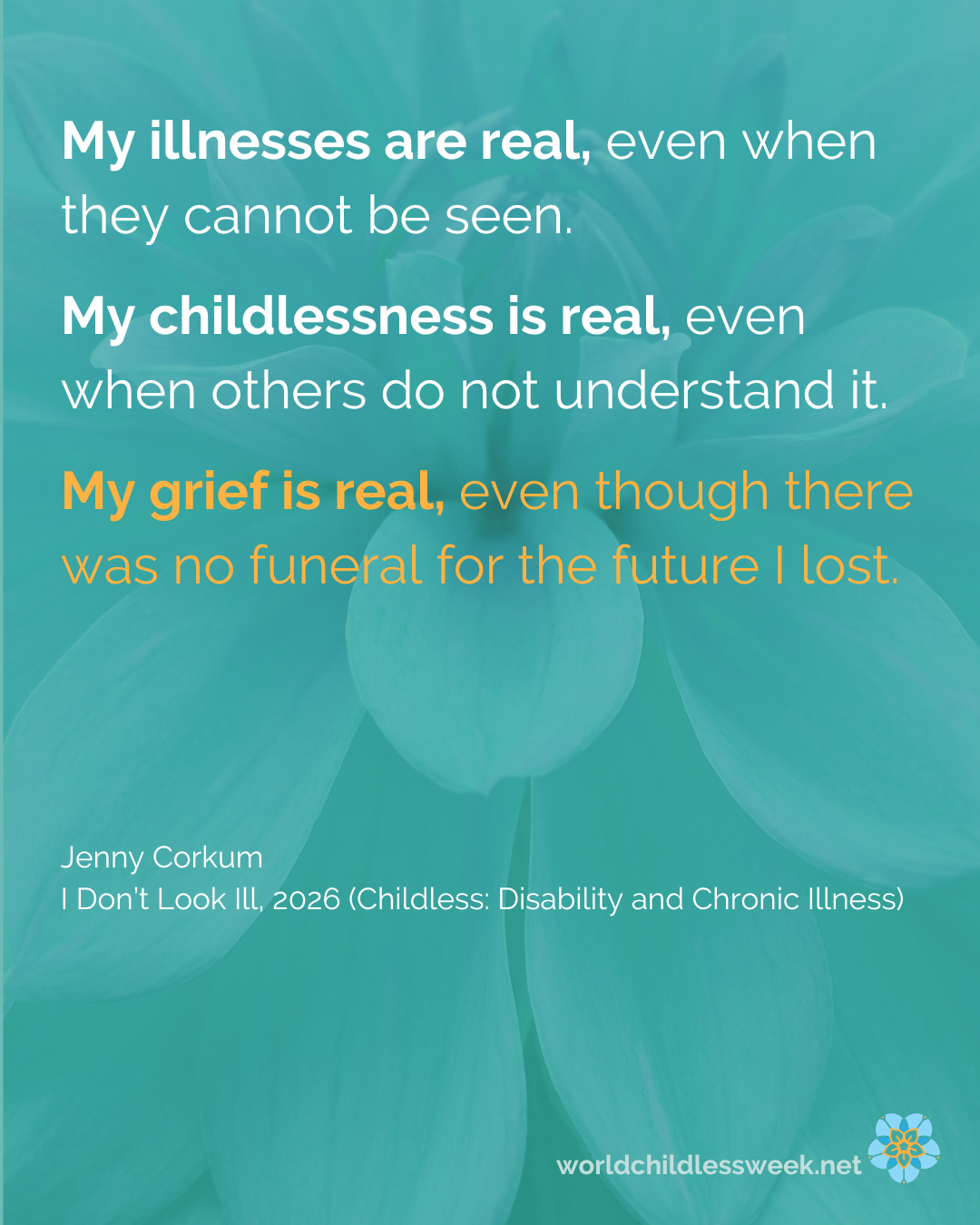
My illnesses are real, even when they cannot be seen.
My childlessness is real, even when others do not understand it.
My grief is real, even though there was no funeral for the future I lost.
But so are my joy, my relationships, my courage, and my purpose.
I am not a fraud because I can smile while living with pain.
I am not childfree.
I am childless—not by choice.
I am living with chronic illness.
And I am still worthy of being believed, understood, and seen.