Frankie Hockham
Mother’s Day can be a beautiful celebration.
It is a day of handmade cards, flowers, family lunches and photographs of proud mums with their children. It is an opportunity to pause and thank the women who raised us, cared for us and helped shape who we are.
But for me, Mother’s Day comes with much more complicated feelings.
I do not see my mum on Mother’s Day.
I know that hurts her, and that makes the day harder. I carry the guilt of knowing she would like to see me, while also knowing that I need to protect myself from a day I find emotionally difficult.
It is not because I do not love her. It is because Mother’s Day brings up feelings I do not always know how to manage, and sometimes the only way I can get through it is by stepping back.
That does not make the decision easy.
While other people are making plans for lunches, buying gifts and sharing family photographs, I often find myself trying to get through the day as quietly as possible.
I tend to avoid social media because I know I will struggle with what I see.
There are photographs of breakfast in bed, handmade cards and smiling families. There are posts about the happiness of being a mum and tributes to mothers who are described as best friends, heroes and everything in between.
I am happy for the people sharing those moments. I do not begrudge anyone their celebration.
But happiness for someone else does not cancel out your own sadness.
For me, Mother’s Day is a reminder that I am not a mum, and not by choice.
For a long time, I assumed I would become one. I imagined that, one day, there would be a child and a family of my own. I thought there would be someone who called me Mum.
Life did not turn out that way.
There can be many reasons why someone is childless not by choice. Fertility difficulties, relationships, timing, health, unsuccessful treatment or circumstances that never quite came together. Sometimes it is not one clear reason. It is a series of moments, decisions and disappointments that gradually lead you to a life you did not expect.
Mother’s Day brings that reality closer to the surface.
People often say that it is only one day and that it can be ignored. But it is not really only one day.
The build-up begins weeks beforehand.
Emails arrive promoting Mother’s Day gifts, flowers, cards and special offers. Restaurants advertise free meals, complimentary drinks and deals for mums. Shops create displays dedicated to motherhood. Social media adverts appear constantly, reminding you to book a table or buy something special before it is too late.
Even when companies offer the option to unsubscribe from Mother’s Day emails, the message itself is still another reminder that the day is coming.
It can feel impossible to avoid.
You can stay away from social media and decide not to go out, but the celebration still finds its way into your inbox, your television, the shops and the conversations happening around you.
There is also a strange tension in trying to explain how the day feels.
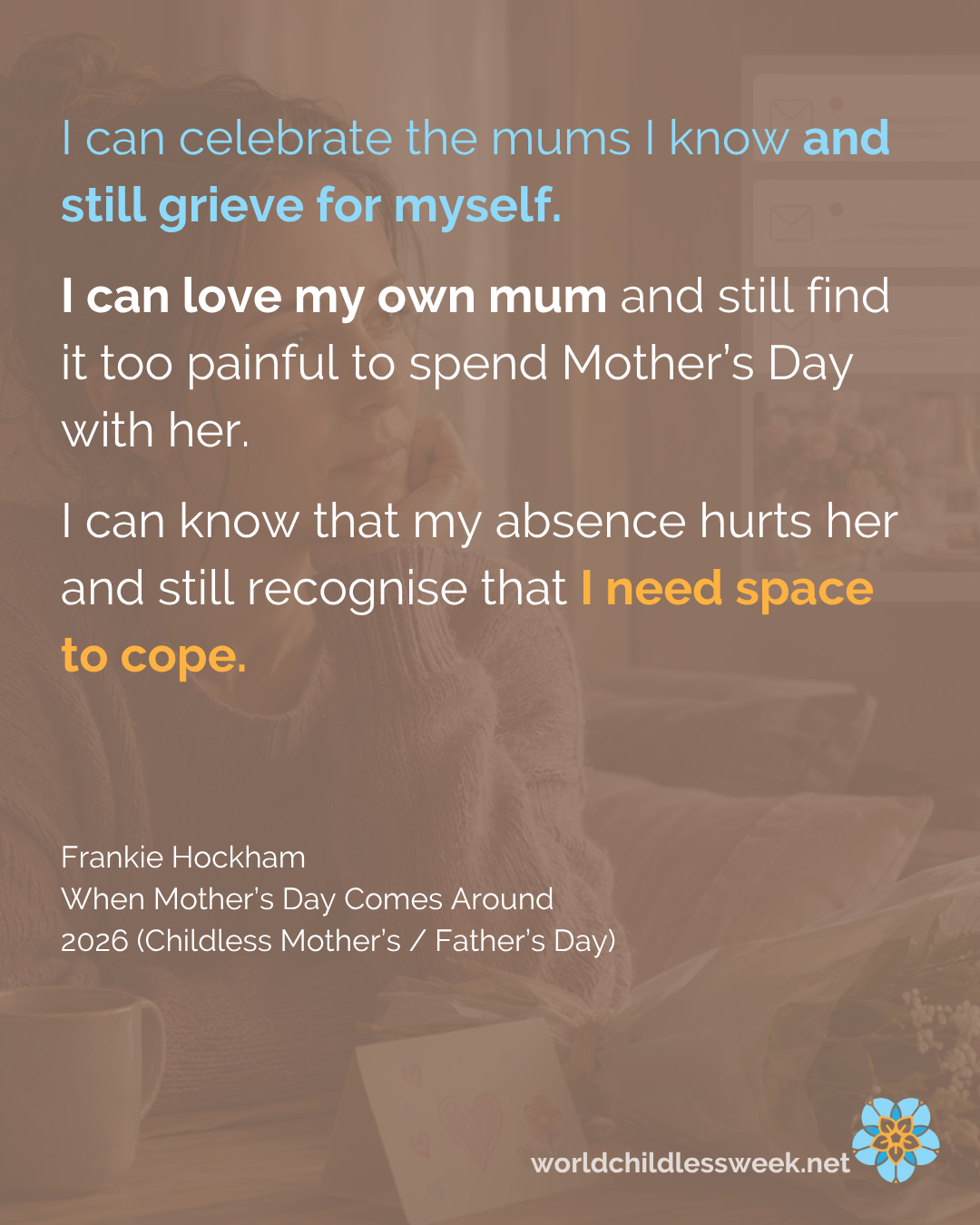
I can celebrate the mums I know and still grieve for myself.
I can love my own mum and still find it too painful to spend Mother’s Day with her.
I can know that my absence hurts her and still recognise that I need space to cope.
I can recognise that motherhood is difficult and demanding while still wishing I had experienced it.
I can be grateful for my life and still feel the absence of the life I imagined.
Those things are not contradictions. They can all be true at the same time.
I am also incredibly lucky to have a good friend who remembers me every year.
She brings me flowers and a card from her son.
It is a small gesture, but it means more than she probably realises. She does not pretend that I am his mum, and she does not try to replace what I have lost. She simply acknowledges the love and care I have given and the place I have in their lives.
For a moment, I feel seen.
When you are childless not by choice, being seen matters.
People sometimes try to comfort you by saying that you are a pet mum, a wonderful aunt or like a mother to other people. Those relationships can be deeply meaningful, and there is nothing wrong with celebrating them.
But they are not the same as having the children you hoped for.
I can love the people and animals in my life wholeheartedly while still acknowledging that the role I wanted most never became mine.
A life without children can still be a full life.
My life contains friendship, love, work, laughter, purpose and people who matter deeply to me. I have care to give, and I give it in many different ways.
But saying that my life is full does not mean there is no grief within it.
Mother’s Day can bring love, sadness, gratitude, anger, guilt and acceptance, sometimes all within the same few hours. There is no simple way to describe it and no correct way to experience it.
Some people will celebrate. Some will avoid the day completely. Some will grieve their mothers, their children or the children they never had. Some will have difficult relationships with their parents and may feel relief, guilt or sadness about keeping their distance.
For some of us, the kindest thing we can do is protect ourselves.
That might mean staying away from social media, declining an invitation, avoiding a busy restaurant or treating the day like any other Sunday. It might mean allowing ourselves to cry, arranging something comforting or spending time with someone who understands.
Mother’s Day should celebrate mothers. Their love, work and sacrifices deserve to be recognised.
But I wish the wider conversation also made room for those of us who experience the day differently.
We are not trying to take anything away from anyone else’s celebration.
We are simply carrying our own stories through a day that can be very difficult to escape.
And sometimes, a card and a bunch of flowers from someone who remembers can make that day feel a little less lonely.