Frankie Hockham
The health care system has broken my heart more times than I can remember.
One of those times, I was sitting in the early pregnancy unit, waiting to hear if my miscarriage was really happening. Around me were women with blooming bumps, partners holding scan photos, excited whispers about baby names. I was silently holding back tears, knowing my dream was slipping away.
When they called my name, the nurse smiled and said she was looking forward to doing my “first scan.” No one had read my notes. No one knew I was there to confirm the end, not the start, of a pregnancy. I had to tell her why. I will never forget the way the room went quiet.
That was just one example.
Every fertility appointment I’ve ever had was in a gynae waiting room surrounded by pregnant women or new mums with tiny babies in car seats. There was no separate space, no sensitivity, no acknowledgement that for some of us those rooms are the hardest places to sit.
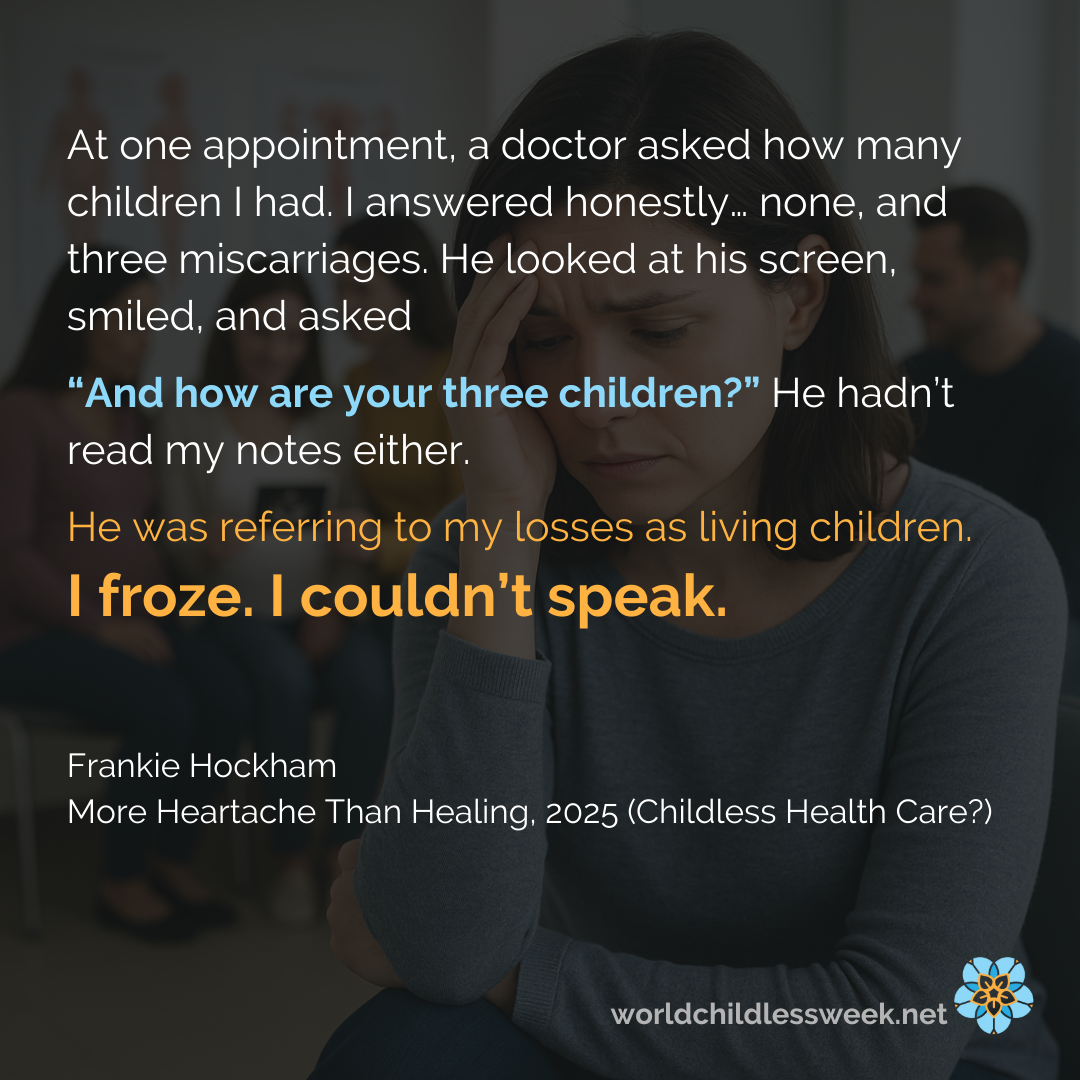
At one appointment, a doctor asked how many children I had. I answered honestly… none, and three miscarriages. He looked at his screen, smiled, and asked “And how are your three children?” He hadn’t read my notes either. He was referring to my losses as living children. I froze. I couldn’t speak.
After my last miscarriage, my doctor used the term “natural abortion.” I know it’s a clinical phrase. I know it wasn’t meant to hurt. But it did. It hit like a slap. Sometimes words don’t just describe an event; they brand it into your memory in the worst way.
IVF was meant to be our hope. During treatment, the fertility clinic staff were kind and supportive. My husband and I felt like we mattered. But when we told them we didn’t want to carry on, we stopped existing to them. There was no follow-up call, no check-in, no offer of counselling or signposting to charities that could support us. Our worth to them seemed to end the moment our bank account closed to them.
Each of these moments left another mark. Not just the pain of loss, but the realisation that the system wasn’t built for people like us. There were no protocols to protect us from avoidable harm. No training to stop the small but cutting remarks. No joined-up care to catch you when you fall out of the “treatment pathway.”
We talk about the trauma of infertility and baby loss as if it’s just about the events themselves - the miscarriages, the failed rounds, the negative tests. But the truth is, the way we are treated within the health system can deepen that trauma. Sitting in rooms full of pregnant women when you’re losing your baby is cruel. Being spoken to as if your children are alive when they never took a breath is devastating. Having your value as a patient tied to your ability to keep paying for treatment is dehumanising.
What I wanted was compassion, or at the very least, carefulness. For staff to read my notes before they called my name. For a waiting room that didn’t make my grief harder to carry. For language that acknowledged my losses without making them feel like a clinical inconvenience. For someone to check on me after it was all over.
What I got was a patchwork of care where the gaps were big enough to fall through. And I did.
I know the NHS is under pressure. I know staff are overworked. I know resources are stretched. But compassion doesn’t cost extra. Reading a patient’s notes before speaking to them doesn’t take much more time. A signpost to a support group takes seconds. A separate corner of a waiting room isn’t a luxury, for some of us, it’s the difference between being able to walk through the door or not.
When I think about the theme of “Childless Healthcare,” this is what comes to mind. Not just the medical losses I’ve endured, but the avoidable pain created by a system that doesn’t yet know how to care for the childless not-by-choice community.
I didn’t expect the health system to save me from grief. But I wish it hadn’t made it heavier to carry.