Emily
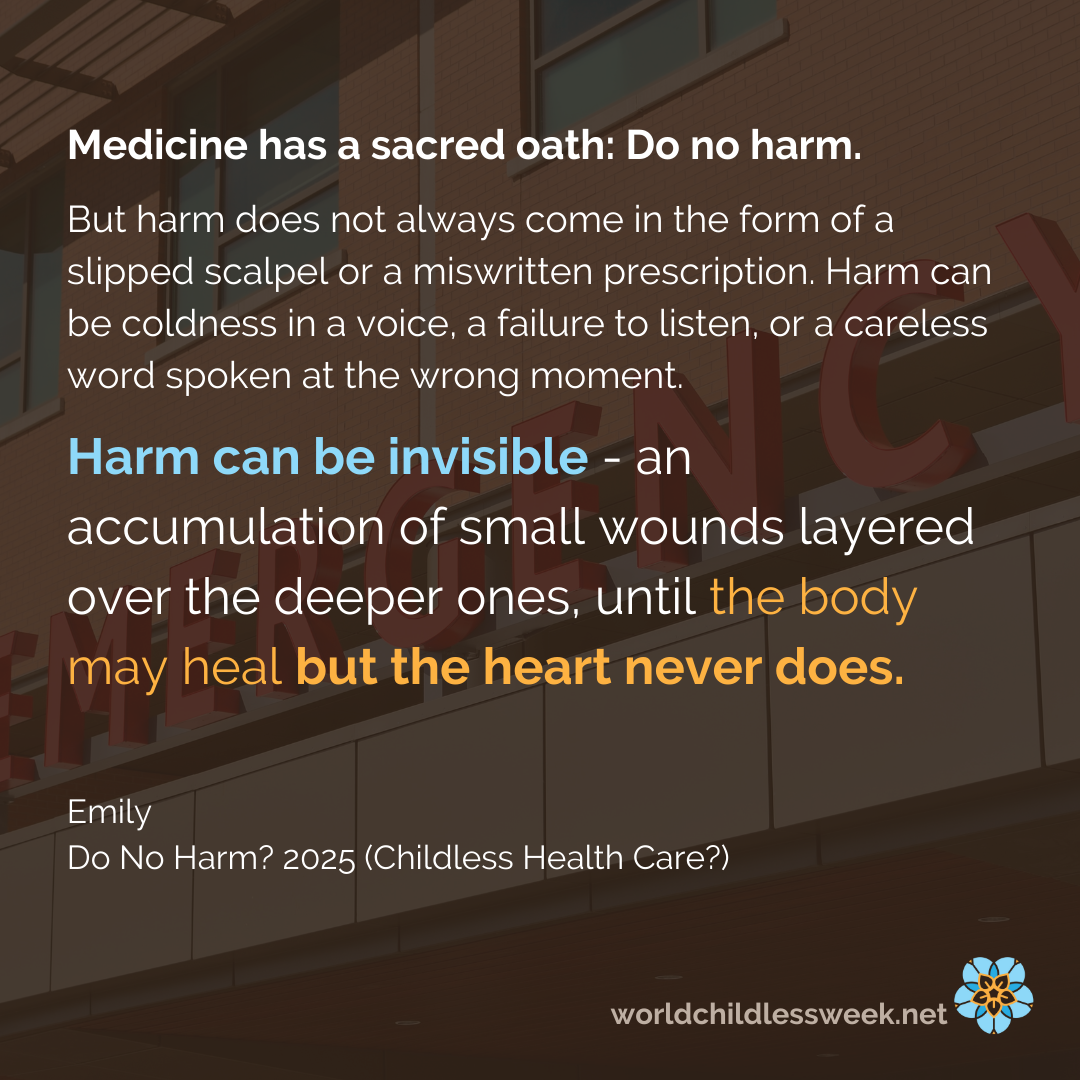
Medicine has a sacred oath: Do no harm.
But harm does not always come in the form of a slipped scalpel or a miswritten prescription. Harm can be coldness in a voice, a failure to listen, or a careless word spoken at the wrong moment. Harm can be invisible - an accumulation of small wounds layered over the deeper ones, until the body may heal but the heart never does.
I entered the healthcare system the way so many do - hopeful, vulnerable, and willing to trust. My first pregnancy was a door into that trust, and it was also the first door slammed shut. The ultrasound room was supposed to be a place of joy, a first glimpse of new life. Instead it became the place where silence stretched, where a technician’s bluntness felt sharper than any instrument. “I don’t see a heartbeat,” she said, and handed me a towel as though wiping away the gel could also wipe away the grief.
From there, a pattern revealed itself: procedures, explanations, reassurances, and dismissals. At the first D&C surgery, the doctor told me not to test the baby, to save the money instead for a vacation. “Miscarriage is so common”. She promised that by Christmas, I’d be holding a child in my arms. These statements were meant as comfort, perhaps, but they were also cages - binding me to timelines, urgencies, and false hope.
Grief did not move in a straight line. It spiraled. A second miscarriage, a D&C that failed, another that cost thousands more. As I left the hospital, I watched new parents buckle their newborn into a new car seat, while I carried only emptiness home with me. My body, I was told, was fine. The tests came back normal. Yet the explanations kept shifting - from egg quality, to uterine issues, to random chance, to unexplained failure. One naturopath even told me it was my subconscious rejecting the pregnancies.
Amidst the confusion, I turned to fertility treatments, clinging to numbers tossed out like lifelines. Eighty percent chance, the Reproductive Endocrinologist told me. Later, I would realize that “eighty percent” was a mirage. The real odds, once stripped of assumptions and hidden conditions, were closer to ten percent. But by then I had signed papers, taken injections, and gone into debt. Hope had been monetized, sold to me in percentages that blurred in my tears.
There were more pregnancies. More losses. More surgeries. Each time I returned, the staff asked me to repeat my story. They never remember me or seemingly read my chart before the appointments. I became a broken record of loss, forced to rehearse my own grief so many times that the retelling itself became another form of harm. And always, the contrast surrounds me in those environments. In the waiting rooms I sit surrounded by glowing bellies and ultrasound photos of tiny hands and feet.
Even therapy, which was supposed to be refuge, became another wound. A counselor, before we had even met, sent me an Instagram video of a surrogate mother pumping milk - telling me I should see myself in her story since she came home from the hospital without a baby, just like me. When I set a boundary and told her the video was not helpful content for me, her response was sharp, accusing, and cruel. I had reached for help, and instead I was told I was hateful for not receiving her “gift” correctly. When I reported it, the system dismissed my pain once again. “No violation,” they said. And so the harm was sealed in silence.
The years unfolded like this - cycles of loss, dismissal, debt, and invasive procedures. And yet, through it, a quieter truth began to take root: survival sometimes means walking away. I stopped chasing answers that did not exist. I accepted, however painfully, the shape of a childless life. It was not the life I had wanted, but it was the only one I could still claim as my own.
And yet even in retreat, harm found me. A blood clot from birth control pills. As I lay on the CT Scan table, a careless nurse cheerfully asked “So, you’ve got a new baby at home?” Her mistake, but the wound was real. And at my yearly OBGYN exam, a new doctor pushed me toward fertility discussions after I had said I was done. As if flippantly suggesting $150,000 surrogacy after reading a few lines in my chart would somehow fix me. I received my pap smear through anxiety and tears. The exam room was filled with posters of smiling infants, as if womanhood itself is measured only in children. A year later, Asherman’s syndrome - scar tissue built up from all those D&Cs. Another $2,000 to clean out the past. Five minutes before surgery, my doctor pulled out her phone to show me a photo of her toddlers making silly faces. As if their joy could somehow undo my despair. As if it was harmless.
The irony of medicine is that while it claims to heal, it often refuses to hear or see.
But not always. There were bright spots - rare, but unforgettable. The ER team during my blood clot emergency who listened, who read my history without forcing me to speak it again and again. The hematologist who answered messages with patience and clarity. The new therapist who finally, gently, simply listened and supported. And one ultrasound technician, who, when delivering devastating news during my second pregnancy scan, placed her hand on my knee. A gesture so small, but in a landscape of coldness, it still glows in my memory as mercy.
Do no harm.
What would our system look like if it understood harm not only as physical injury, but as the erosion of dignity, the silencing of grief, the careless cruelty of words? If it understood that healing sometimes begins not with a prescription, but with a pause - a moment to see the person, not just the patient?
I do not know the answer. But I know the cost of its absence. My story is built of scars, both visible and hidden. And I wonder: how many others walk among us, carrying their own invisible wounds from a system that never meant to harm them, but did all the same?