Frankie Hockham
On the whole, I have been lucky when it comes to taking time off work.
In most of the places I have worked, annual leave has been handled on a first come, first served basis. Nobody has openly suggested that my request mattered less because I do not have children or assumed that parents should automatically be given priority.
To be honest, I do not usually want time off during the school holidays. I am often happy for colleagues with young families to have that time together, and I can take my holidays when places are quieter and prices are lower, which suits me.
Christmas is slightly different, because I genuinely love the magic of it.
Every year, I enjoy going to the Santa’s grotto at my local pig sanctuary. It might not be the sort of Christmas tradition people expect from someone without children, but it brings me so much joy. I love the decorations, the atmosphere and the sense of excitement. The fact that I do not have children does not mean that Christmas is any less special to me.
That is why assumptions can be difficult.
There is a real difference between choosing to be flexible and having other people assume that you will be. I have been fortunate that this distinction has usually been respected in my workplaces, but I know that is not everyone’s experience.
My husband has had a harder time.
People have sometimes assumed that he does not need particular days off because he does not have children. He has also been left out of certain events or activities because they were seen as being for people with children.
Perhaps nobody intended to exclude him. They may even have thought he would not be interested. But it can still hurt when somebody else decides that you do not belong, without asking you.
Not having children does not mean that you do not enjoy celebrations, traditions or spending time with the people who matter to you. It does not mean that Christmas, Easter, Halloween or any other special occasion has no meaning. It simply means that your life and relationships may look different.
There is also an assumption that people without children have more time.
When somebody is needed to cover an event, stay late or take on something at short notice, I often feel that people without children are asked first. The unspoken thinking seems to be that it will be easier for us because we do not have children waiting at home.
But our time is not empty.
We may be caring for elderly parents, supporting friends, spending time with our partners or looking after pets who depend on us. We may have appointments, voluntary commitments or plans that are deeply important to us. Sometimes we may simply need an evening to rest, and that should be valid too.
One of the most uncomfortable moments is saying that you cannot attend something because you are busy and receiving a look that seems to ask, “Busy doing what?”
It can make you feel as though you need to provide evidence that your plans are important enough. As though being childless means you must explain how you could possibly have anything else to do.
I should not have to list my responsibilities or reveal personal details to prove that my time matters. Saying that I am unavailable should be enough.
This is not about criticising parents or suggesting that they should receive less support. I completely understand that children become ill, childcare arrangements fall through and emergencies happen. Parents need understanding and flexibility when those situations arise.
I just believe that the same understanding should be available to everyone.
Caring does not only mean caring for a child. Family does not only mean parents and children. Responsibility does not become less real because it involves an elderly relative, a partner, a friend or a pet.
Likewise, time off does not have to involve a caring responsibility to be worthwhile. People without children are entitled to celebrate religious festivals, maintain traditions, take holidays and enjoy their lives without having to justify why those things matter.
During World Childless Week, I think it is important to challenge the idea that people without children have fewer responsibilities, fewer meaningful relationships or less need for time away from work.
My experience has largely been positive, and I am grateful for that. But I have also seen how quickly assumptions can be made, particularly through my husband’s experiences and in the expectation that childless people will be the easiest ones to ask.
Sometimes I will happily be flexible. I may volunteer to work during a school holiday or choose not to take leave at a busy time. But flexibility should be offered freely, not treated as an obligation.
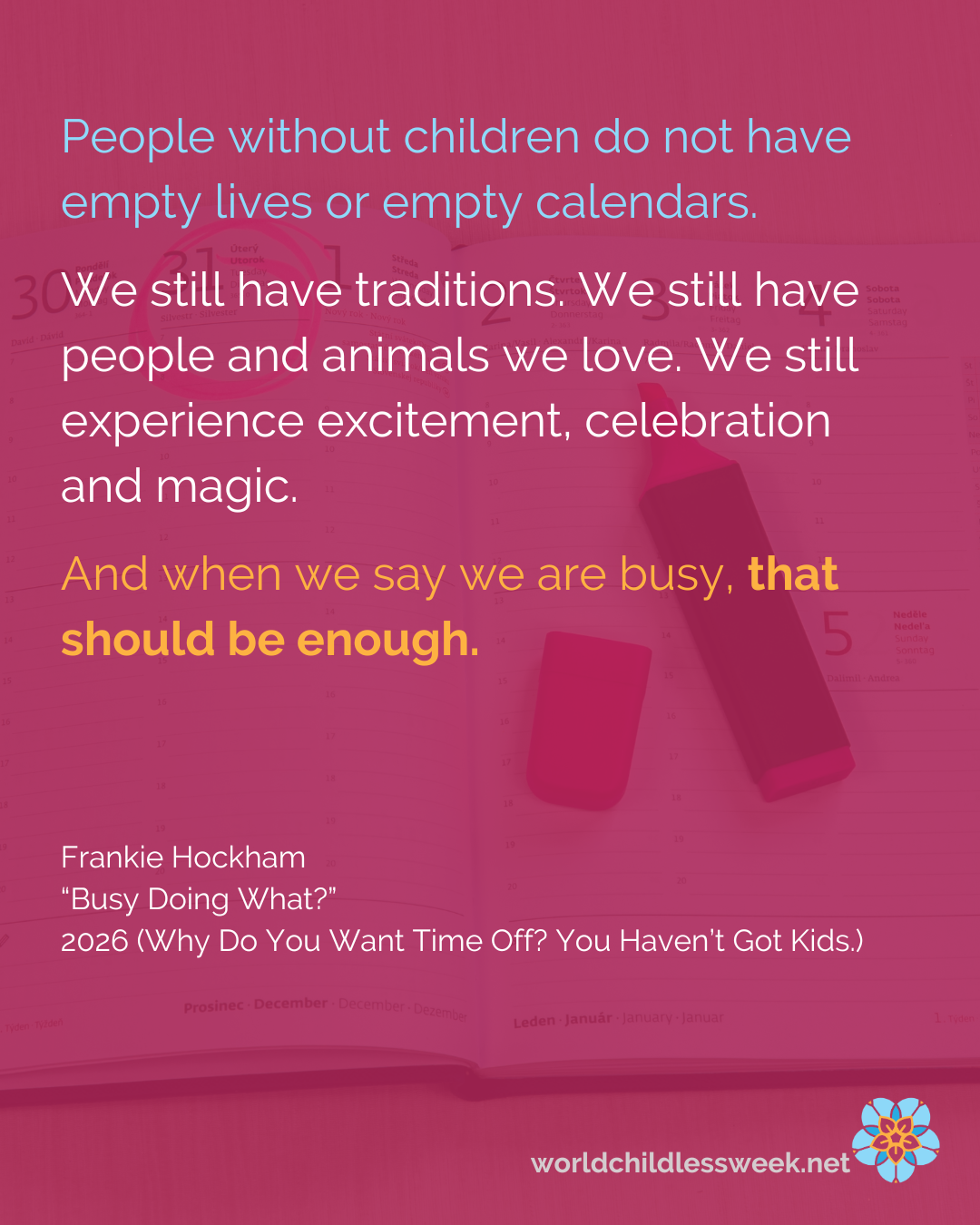
People without children do not have empty lives or empty calendars.
We still have traditions. We still have people and animals we love. We still experience excitement, celebration and magic.
And when we say we are busy, that should be enough.