Meriel Whale
World Childless Week Ambassador
A living being goes through lifecycles that are easily recognisable and that we may have studied at school. Think of a frog for example – eggs are laid and a tadpole emerges, grows legs and arms to become a froglet, grows bigger and bigger to become an adult and eventually lays its own eggs and the cycle begins again. A plant also has a lifecycle, from seed to sprout, producing seeds of its own. A leaf on a tree emerges, grows, changes from green to orange or brown and then falls, to nourish the soil it grew from.
Mammals often go through different processes, and not all mammals become parents. Not all humans become parents. This we know to our cost. But we still have a lifecycle and we still go through recognisable phases and stages. They will be different for different people, of course. No two humans experience childlessness (or anything else) in the same way, our uniqueness applies to the experiences we have as well as our essential selves.
I have written about these cycles before, in the context of our journey through grief. Grief can sometimes feel like a circular event with no end. I have suggested that, although we walk the path of grief for what feels like a long time, that each journey around the path is slightly different to the one before, especially when some kind of support is available. I also feel that having some idea of a path is helpful, a guide, a route map, someone who has walked this path before us and can make us feel less lost, less alone.
And so in this blog, I am going to write about the lifecycle of a childless person, a fictional childless person but one loosely based on me and on my experiences. This is because I am the only person I can write about with any authority, and to preserve the privacy of other childless people I know. I’ll end with two quotes from childless friends about where they see themselves now.
JAY’S STORY
After more than ten years of struggling to become a parent, Jay reached a day in June 2015 when she had to acknowledge that her journey to becoming a parent was over and that she was facing a life as a permanently childless person. For various reasons, it was hard for her to fully grieve this loss, although she did notice both anger and shame. Sadness, however, was pushed away as, at the same time, she was facing redundancy and the loss of a parent as their ill health worsened. This is not uncommon – grief rarely strikes us when we have the time, the capacity or the support network to fully experience and process it and Jay was young in the process of grieving, unsure and frightened.
Jay felt completely lost in her grief, sinking, drowning, as if she knew nothing and could do nothing, as if she was completely alone. It felt as if no-one could understand or help her to grieve, no-one was interested, and there was no-one to talk to – her closest friends were all parents.
Grief heals us but we cannot do it alone. We cannot ‘wait it out’. Time does not heal; grieving heals. But it cannot heal until it is witnessed and held jointly, with great tenderness, in the heart and soul of another.
Jody Day
Jay had two choices at this point in her lifecycle, to go to ground or to reach out to others to help her to grow. It was easier to go to ground, to allow herself to be a seed for a while, planted, waiting in the dark earth, dealing with too much. But after a few months of this, almost a year, she saw that an organisation she had connected to three years earlier, while she was still trying, was offering a one year course on finding your Plan B when Plan A has crashed to the ground and you are sitting in the rubble, asking ‘What next?’ to the empty air. Jay signed up. On the very first day, she met someone else who had had the very same, and quite unusual, journey to childlessness that she had also had. The hard case around the seed cracked open a little, and Jay let it. Over the year, tiny shoots began to grow, although not as fast as Jay would have liked.
On the last day of the course, Jay broke down completely, letting out all the sadness, grief and shame she had been holding onto for so long. This was not the end of her grief journey, it was the beginning. The course and the people on it had shown her a new path, and she had taken it in her time – the right time for her, no-one else. Jay allowed the sadness to continue to move through her, using the power of tattoos and jewellery to symbolise and allow her to process her grief, and to make her Plan B visible, into images she could see every day.
Jay had a tribe of people like her, a place to take the ongoing feelings and challenges she experienced, and to support others with theirs. She began to work with other childless people as a counsellor for individuals and couples, and to explore two new careers to do alongside counselling.
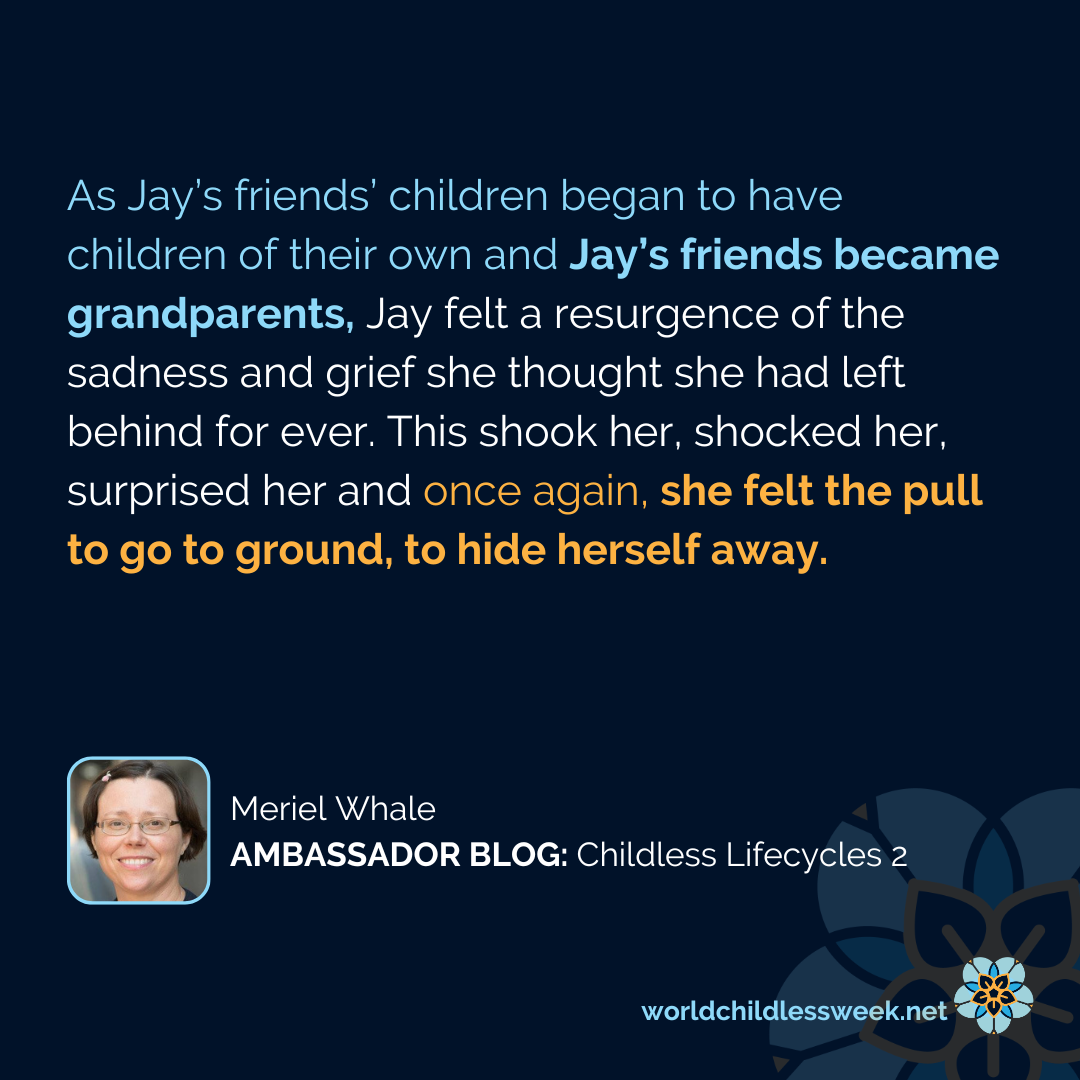
But paths are rarely completely straight and it is common to stop or even feel as if you are falling backwards from a place that felt secure, all your hard won progress leaving you piece by piece, leaving you empty handed again. As Jay’s friends’ children began to have children of their own and Jay’s friends became grandparents, Jay felt a resurgence of the sadness and grief she thought she had left behind for ever. This shook her, shocked her, surprised her and once again, she felt the pull to go to ground, to hide herself away.
But Jay had been here before and this time, she knew what to expect and she knew what she wished she had done the last time this happened – to give her grief words, to let herself cry and mourn without fear or censoring, to reach out. Alongside this, noticing she was beginning to fear a future when she would age without adult children to support her, Jay began to write down what she was afraid of, the kind of old age she wanted, and how she might be able to put things in place when she was still in her fifties, like taking up online strength training with a childless trainer. And Jay began to write novels where the protagonists were childless and this was not the plot, it was merely incidental.
Jay had a Plan B, the beginnings of a plan for her childless old age and she had people around her who knew what she was experiencing and understood. Her childless life cycle was not complete, of course, but Jay felt a maturity and a capacity to keep moving forward, not alone, with whatever happened next.
QUOTES to end
I’ve now stopped standing at the door that never opened and turned around. What’s behind me — the life I’ve actually lived — is fuller than I ever gave it credit for, and a profound, defining part of it. But I’ve learned that a life shaped by unrealised parenthood is still, beautifully and stubbornly, a life. The grief and loss were real, as is everything I have chosen to build in its wake. I intend to live the rest of my life with acceptance, meaning and juiciness, knowing that this is all possible. TJ
I don’t know if the grief is smaller, or if my life has simply become bigger. Childlessness challenged me deeply and required me to rethink what a meaningful life could look like. Through courage, self-reflection, friendship and community, I created a life that is rich,meaningful and authentically my own. That’s something I’m genuinely proud of. MT